Cold Email Personalization at Scale Using AI
AI can personalize cold emails at scale when signals drive copy and humans verify before sending.

Cold email personalization at scale using AI requires a different research system. It works best when it starts with current signals, uses AI to link them to an offer that fits, and has a human check the email before delivery. Scale comes from automating research and drafting without surrendering judgment about what deserves to be sent.
Why merge-tag personalization no longer works
A name, company, and title identify a recipient, but they do not explain why that recipient should care. When those fields sit inside an otherwise identical message, the underlying pitch remains interchangeable. Prospects have spent a decade learning to read past these openers. Instantly describes an inbox where recipients recognize within seconds whether an email was written for them or fired at a large list. Spam filters have also learned to recognize template-level personalization.
AI has made this problem harder to escape by reducing the cost of producing personalized-looking copy to near zero. A company reference does little to distinguish an email when the sentences around it follow a familiar formula. Faster generation multiplies the pattern.
Salesmotion identifies the “compliment trap” in broad remarks about a company’s industry or mission and congratulations on stale funding news. These openings look like research but say little about what is happening with the prospect now. The personalization is built around a reusable structure, with no signal that changes the reason for writing.
What genuine personalization actually requires
Genuine personalization requires a sentence that could not have been sent to anyone else on the list. That sentence must make a specific, verifiable claim recent enough to show that the outreach reflects the prospect’s circumstances. MapsLeads expresses the standard through a comparison between colleagues’ copies of the same email. If the recipient would recognize the messages as different, the personalization has substance. If not, the sender has changed fields while leaving the meaning unchanged.
The opener is the first unit to get right because it is the sentence the prospect reads with full attention. Research spent customizing other parts of the message cannot compensate for an interchangeable opening. However, a specific observation is not sufficient by itself. The bridge line must connect that observation to the reason for contact, so the detail earns its place.
MapsLeads limits the custom portion to the opener, the bridge line, and sometimes the CTA. Roughly twenty to thirty percent of the email is custom content, while the value proposition, social proof, and PS can come from a tested template. Even so, finding a defensible observation and connecting it to an offer can take hours per prospect.
How signal-based enrichment makes this standard achievable at scale
Signal-based enrichment automates the search for evidence that fits the prospect, taking over the work of browsing by hand. Airtop describes three layers, which are firmographic relevance, persona-based pain points, and timing and behavioral triggers. Recent company activity establishes context, the prospect’s role identifies likely challenges, and behavior or organizational change supplies a reason to write now. Together, these layers give AI something to reason from. The improvement comes from the data beneath the copy.
Useful signals are public, structured, and refreshed often. MapsLeads identifies recent reviews as strong anchors for local and SMB outreach because a reviewer’s exact words refer to a real, recent situation. Changes in ratings and review milestones offer different hooks, while photos of the business show what the company is promoting now. Changes to opening hours can indicate hiring or expansion. Business anniversaries and recent mentions in the local press add context without broad claims about how long the company has been around or how well it has done.
Outreach to enterprise and mid-market prospects needs different evidence. Instantly points to funding announcements, changes in leadership, strategic job postings, and the prospect’s blog posts or LinkedIn comments on content from competitors. Intent data from providers including Bombora and Demandbase adds evidence of behavior through the websites prospects visit, what they download, and the content they consume. Instantly describes the targeting value of combining that intent with buying signals such as a Series B raise and a VP of Sales hire. The combination is more informative than either an account attribute or an isolated event.
Signals can also change the direction of follow-up copy. Salesforge describes dynamic content that adapts to recipient behavior in real time. If a prospect recently browsed a pricing page, the next email can shift from product features to ROI calculations.
The production stack and the path from raw signals to sent email
A production system has three separate jobs to do, which are enrichment, AI-driven copy generation, and delivery. Salesmotion evaluates tools against personalization depth, scalability, deliverability, and speed to send. No single tool wins all four, so most teams stack two or three. The useful comparison is therefore which bottleneck a product addresses and how it connects to the next layer.
Clay provides a spreadsheet-like interface for chaining enrichment, AI prompts, and conditional logic. Its waterfall logic queries another provider when an earlier source misses a contact, giving teams control over how coverage is built. Salesmotion reports that sequential provider lookups consistently outperform single-database providers on coverage. Clay has a high ceiling but a real learning curve, making it suited to revenue operations teams and technical SDRs. Salesmotion’s Outreach Agent takes a more focused enterprise approach, using earnings calls, leadership changes, and live buying signals to produce a ready-to-review draft in under two minutes with every claim sourced.
Once enrichment supplies context, the writing layer turns it into copy. Instantly’s AI Sequence Writer builds multi-step sequences from guided inputs, offer details, audience information, case studies, and the requested number of steps. Dynamic variables hold the personalization fields, while Liquid Syntax and conditional template logic can choose wording based on the role, industry, or type of signal. Those capabilities are distinct from reasoning over a signal to create a unique opening line. Airtop’s Mark gathers signals, handles enrichment, and writes personalized messages in a workflow that starts with a single conversation, without anyone having to chain tools by hand.
All-in-one platforms offer another trade-off between control and convenience. Apollo.io combines a large contact and company database, direct dials, verified emails, an AI writer, and a sequencer for SMB and mid-market teams seeking one platform. Its free tier supports testing and light prospecting but is limited for solo reps doing substantial outbound. Snov.io combines its ICP-based Email Builder with lead finding, validation, warm-up, and sequence tracking. Smartlead emphasizes sending capacity through unlimited email accounts, inbox rotation, automated warm-up, AI personalization, and consolidated replies. Salesforge combines AI SDR Agent Frank, email validation, multilingual support, and unlimited warm-up via Warmforge with research, message creation, follow-ups, and meeting scheduling.
What happens when the AI generates copy without a human quality gate
A capable stack does not make an unreviewed draft ready to send. AI reasoning models can fabricate funding rounds, assign incorrect role titles, or describe activities that never happened. These errors are especially damaging because the recipient may know immediately that the claim is false. A single invented detail can discredit the rest of the message. Basing the draft on sources lowers that risk, but a human still needs to check the claim before the email goes out.
Accuracy is only one part of that review. Instantly identifies the familiar opening about having noticed the recipient’s company as a canonical AI pattern. Recipients do not need a classifier to recognize wording they have already learned to dismiss. Removing that voice requires more than substituting synonyms in the opening phrase. The draft must make a relevant observation and carry its meaning into the reason for writing.
A custom first line followed by an untailored pitch can perform worse than no personalization at all. It shows attention to the greeting but not to the offer the prospect actually evaluates. The tested offer must fit the segment and follow logically from the signal. Otherwise, the research and the pitch belong to different conversations.
Segmentation helps allocate that judgment where it matters. MapsLeads describes small clusters of fifty to two hundred prospects sharing one strong attribute, with an opener drawing from two or three structured fields and typical reply rates of five to ten percent. That approach differs from deeper one-to-one research and avoids giving every contact the same research budget. The quality gate is the same for every segment, with a human checking the facts, removing formulaic AI language, and making sure the offer fits. AI does the research and drafting, but an editor checks its work just as closely as a junior writer’s draft.
Deliverability as the ceiling the personalization system must stay under
Even copy that is accurate and fits the prospect fails if it never reaches the inbox. Airtop states that proper SPF, DKIM, and DMARC setup is mandatory in 2026. Instantly notes that Google and Yahoo enforce authentication, one-click unsubscribe, and spam-complaint ceilings for bulk senders. These requirements make delivery a design constraint. The campaign must fit the sending infrastructure.
The practical spam complaint ceiling is now 0.10%, and the rate applies across the domain. One careless campaign can therefore damage delivery for other teams sharing that domain. Gmail moved from soft deferrals to temporary and permanent rejections for non-compliant mail. Microsoft joined authentication enforcement in May 2025, although it does not publish a specific numeric complaint-rate threshold as Google and Yahoo do. The operational window for high-volume sending is consequently narrow.
When a campaign sends a high volume of emails and gets little engagement, it looks like spam-like activity to ISPs, which hurts reputation and sends later messages to spam. Lower inbox placement then further reduces engagement. Instantly describes indiscriminate sending as actively damaging because it trains filters and burns domains that took months to warm. Recognizable AI voice and shallow personalization compound the problem when automated generation drives greater volume.
Warm-up services, inbox rotation, and sender rotation help manage the infrastructure side of this constraint. Salesforge and Smartlead address warm-up and inbox rotation within their platforms. These measures do not substitute for relevance or provide permission to ignore complaints. Smaller lists that are better targeted get more engagement than large lists.
What the full system looks like end to end
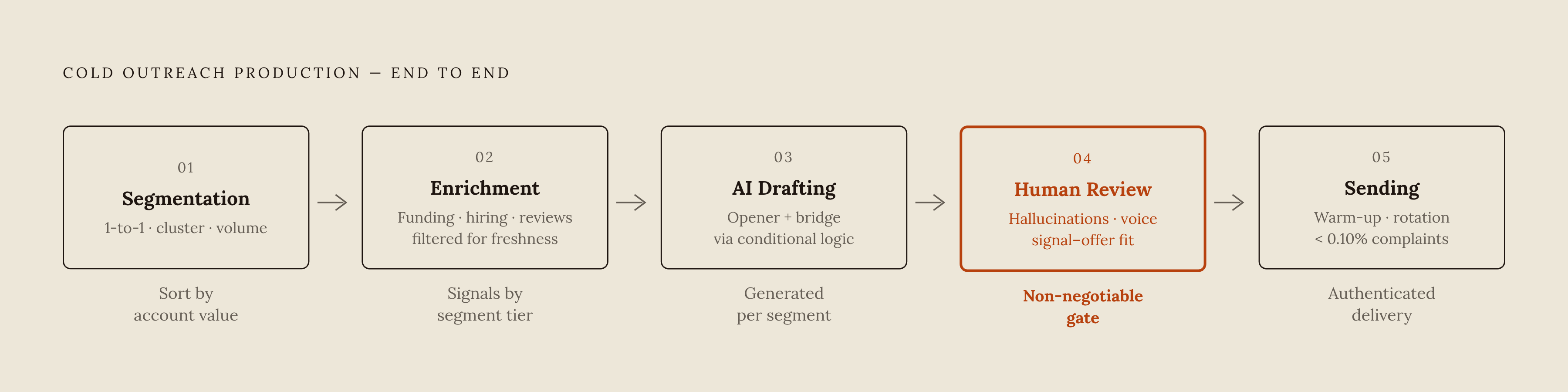
The signal-based system resolves that tension by separating research, drafting, review, and delivery into connected stages. Each stage has a defined job, and its output becomes the input for the next. Segmentation comes before enrichment consumes time or budget. Prospects fall into one-to-one, small-cluster, or volume tiers according to account value, which determines research depth, tool choice, and reply-rate expectations.
The segmented list then enters a waterfall enrichment workflow. Enterprise accounts call for funding, leadership, hiring, and earnings-call signals, while local and SMB accounts call for reviews, ratings, photos, and anniversaries. Freshness is part of the selection, since a funding round from eight months ago is not a timely reason for contact. Enriched signals then pass into the AI writing layer to generate the opener and bridge line. Conditional logic routes the appropriate copy by segment, producing a draft.
Salesmotion’s Outreach Agent sits across the enrichment and drafting stages for enterprise teams, grounding sourced claims in live signals. Whatever tool produces the draft, the next stage is human review for hallucinations, formulaic voice, and offer-to-signal mismatch. The reviewer confirms that the offer fits the segment and keeps the message concise. Approved copy then enters authenticated sending infrastructure with warm-up, inbox rotation, and complaint monitoring against the 0.10% ceiling. Teams still need to track deliverability after the campaign starts.
The complete system combines a technical foundation, signal-based research, and a human-edited message. AI removes much of the repeated work required to find evidence and turn it into a draft. Speed and specificity can coexist because the system automates the work around human judgment.