AI SDR Agents vs Human SDRs for Outbound Pipeline
The best teams assign AI and humans different roles rather than picking a winner.
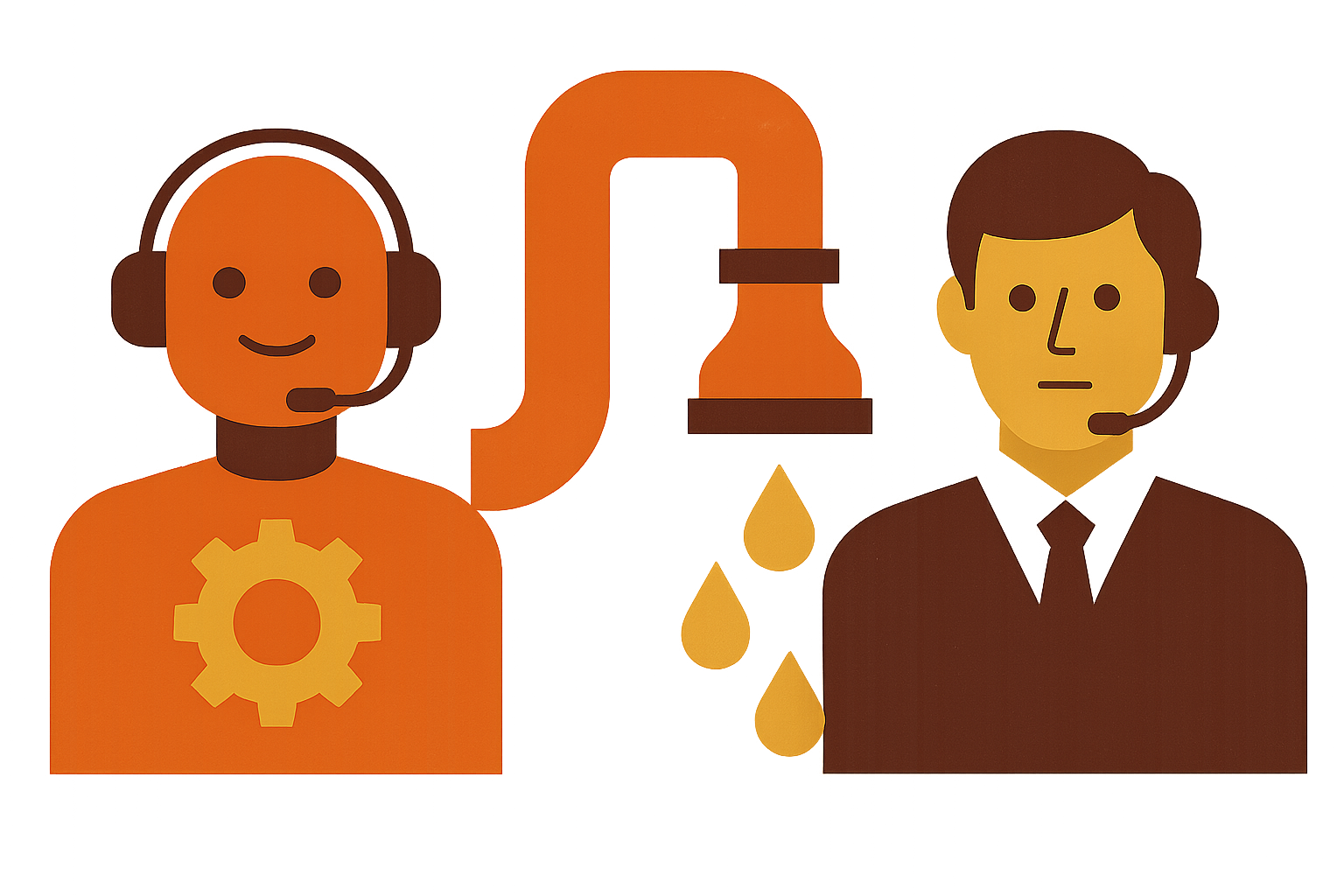
"AI SDR vs human SDR" is the wrong question, and treating it as a contest is what causes teams to leave pipeline on the table. The two don't perform the same tasks well, so framing this as a winner-take-all matchup obscures the actual decision in front of most revenue leaders: which role should each one fill inside a single outbound motion. The category itself has split into two distinct architectural philosophies. One camp builds fully autonomous agents meant to replace the SDR role. The other builds human-in-the-loop copilots meant to amplify what a rep already does well. That choice between architectures carries real consequences downstream, shaping not just how much pipeline gets generated but how much of it converts. Everything that follows builds toward a single point: the teams getting this right in 2026 aren't picking a side, they're assigning roles.
What AI SDR agents do and do not do
An AI SDR runs the full top-of-funnel workflow end-to-end: prospecting, enrichment, personalized outreach, sequence management, reply handling, and meeting booking. It is not a chatbot bolted onto a CRM, and it is not a mail-merge tool with a better interface. The systems worth paying attention to pull prospect-specific signals, such as a recent funding round, a job change, or a shift in a target account's tech stack, and adjust send timing based on behavioral patterns rather than firing off generic blasts on a fixed schedule.
The market has settled into three distinct architectures, and if you conflate them, you end up making bad buying decisions. Fully autonomous agents source prospects, write and send sequences, handle replies, and book meetings with minimal human input, and they suit high-volume top-of-funnel motions against a broad ideal customer profile. AI copilots embedded inside platforms like Outreach or Salesloft take a different approach: they optimize sending and drafting but still need a rep to direct the work. They speed up execution without improving the account intelligence underneath it. Intelligence layers take a third path entirely, focusing on signal synthesis and account research rather than sending anything at all, and handing better raw material to whatever execution engine, human or AI, acts on it next.
None of these architectures solves two hard constraints baked into the channels themselves. Autonomous agents face platform-compliance risk if they operate at scale on LinkedIn, and under US law, you can't use AI to place cold calls without prior express written consent. That confines most autonomous agents to email and LinkedIn, regardless of how sophisticated their targeting gets.
What human SDRs do with their time
Human SDRs remain irreplaceable for a specific class of work: tasks that require real-time judgment, an accurate emotional read, and the ability to navigate a relationship as it shifts in the moment. Navigating a complex buying committee, reading the tone of a defensive gatekeeper, building rapport with a skeptical VP, handling a layered objection, aligning multiple stakeholders toward a single decision: none of this is automatable in any meaningful sense, and none of it is in question here.
The rest of a skilled SDR's week goes to work that doesn't require that judgment. Researching contacts, building lists, drafting initial outreach emails, logging activity in the CRM, chasing prospects who never reply: this is repetitive work, and it's expensive precisely because a trained, relationship-capable person is the one doing it. A fully-loaded human SDR costs salary, benefits, manager time, tooling, and a multi-month ramp before that rep books a first meeting. Every hour spent on list-building instead of relationship-building is a cost with nothing to show for it on the skill side. Add to that a basic structural ceiling: a human SDR handles one conversation at a time and sustains peak focus for a limited number of hours in a given day. It's an upper bound on how much any one person can produce, no matter how good they are at the job, not a performance issue to be coached away.
Where AI wins clearly: volume, ramp time, and coverage
On raw output, speed to first send, and geographic coverage, AI SDRs hold a structural advantage, and no amount of human effort can close it. Per-rep monthly outbound volume has risen substantially in AI-augmented configurations compared to human-only baselines, and the multiplier is large enough to change how teams think about coverage and sequencing cadence. Ramp time tells a similar story: AI SDR seats reach their first booked meeting in weeks, not the months a new human hire typically needs to get there. If your team needs pipeline now rather than next quarter, that difference changes what you can do in a given fiscal period.
Coverage compounds the gap further. A human SDR can realistically maintain only so many active accounts at once. An AI system works multiples of that figure in parallel, across time zones, without fatigue and without the prioritization trade-offs a human rep has to make every morning about which accounts get attention today. Signal-based targeting sharpens this advantage rather than diluting it: leadership changes, funding rounds, hiring surges, and competitor complaints replace static contact lists as the basis for outreach, and AI systems built to ingest those signals in real time get meaningfully better raw material to work from than any list pulled from a database six months stale. The real effectiveness gap between AI deployments appears there: the quality of the signal layer decides how much of the volume advantage turns into relevant outreach.
The adoption numbers back up the bet teams are making. Enterprise AI SDR production adoption has grown sharply over a single year, and B2B SaaS, cybersecurity, and cloud infrastructure companies are leading that shift. They're production deployments, in categories where outbound has historically been the most expensive line item in the GTM org.
Where the volume gains come at a cost: quality, deliverability, and the authenticity gap
The same scale advantage that makes AI SDRs attractive can measurably damage reply quality, inbox deliverability, and buyer trust if it runs without a human checkpoint anywhere in the loop. Reply rates fall as volume rises: as per-rep outbound volume increased in AI-augmented configurations, raw reply rates declined, confirming that sending more emails doesn't produce a proportional increase in pipeline.
Quality erosion at scale is well documented. When AI writes and sends thousands of messages without a human reviewing them, output quality tends to slip, and G2 reviewers across autonomous AI SDR platforms say they get generic, templated messages that prospects can spot as automated on sight. Deliverability compounds the problem into something closer to a hard ceiling than a manageable risk: domain reputation collapse from over-sending is a documented failure mode that has capped a significant share of AI SDR deployments within their first months of operation. Once a sending domain's reputation takes that kind of hit, no amount of signal sophistication recovers it quickly.
Buyers in 2026 can detect AI-generated outreach, and more of them are filtering it out before it ever reaches a decision-maker's attention. A fully autonomous agent that strips the human element out of outreach also strips out the authenticity that drives genuine engagement. The teams getting the best results aren't the ones who bought the most autonomous system on the market. They built the intelligence layer correctly before they scaled the volume on top of it.
Where human judgment sets the ceiling on what AI can close
Above a certain threshold of deal complexity, human judgment becomes a prerequisite for the deal closing. Large deal sizes, multi-stakeholder buying committees, long sales cycles, and categories where trust is the product itself all demand something pattern-matching systems don't yet replicate.
The clearest evidence of this is visible downstream of the booking itself: meetings booked by AI SDRs convert to qualified opportunities at a lower rate than meetings booked by human SDRs. The volume advantage AI delivers upstream does not carry all the way through to pipeline quality on the other side of the funnel. The deal-complexity ceiling is the clearest structural boundary in the whole comparison. If you run high-volume outbound against a broad ICP with smaller deal sizes, autonomous AI agents can handle most of the SDR function on their own. For enterprise deals running through a complex buying process, that gap widens considerably, and it widens because the later stages of a deal, discovery calls, demos, multi-stakeholder alignment, objection handling, all demand the kind of real-time reading and relational judgment a system trained on patterns cannot supply.
Phone runs into the same limits. Connect rates on cold calls are low across the industry, and because the law restricts AI-initiated calls, autonomous agents can't own the one channel that has historically produced the highest-quality conversations in outbound. It's a boundary set by what a buying decision actually requires once the stakes and the number of people involved both go up.
How the hybrid model works: pod composition and role definition
The teams generating the most pipeline per dollar in 2026 run hybrid configurations pairing AI and human SDRs. They run defined hybrid configurations, so each side of the pod does the work it is structurally built to do better. Pod composition is the lever that matters here: hybrid pods pairing one human SDR with AI SDR seats outperform both pure-AI and human-only configurations on meetings booked per dollar spent. The ratio between the two, not the binary choice of one over the other, is what teams should be optimizing.
Two cases from 2025 make this concrete. Jenny Sung, Perplexity's Product Marketing Lead, built an enterprise GTM motion with Unify and zero BDRs on staff, automating the booking of more than 80 enterprise meetings and driving significant early pipeline. The motion was signal-driven: it targeted decision-makers at companies already using Perplexity's free or Pro tiers. Justworks also worked with Unify, and within five months it turned intent signals from 6sense and G2 into automated sequences to get strong ROI. In both cases, the quality of the intent data drove the result. Volume alone did not.
Amplemarket's Duo Copilot illustrates the human-in-the-loop design principle in practice: AI monitors signals, researches prospects, and drafts campaigns, while the rep decides how much of that work runs hands-free, whether that means approving each message individually or setting autopilot within guardrails the rep defines in advance. Either way, the rep still adds personal context before anything reaches a prospect's inbox, and that is what preserves the authenticity that drives real engagement even as volume scales.
Inside a working hybrid pod, you can see exactly who does what. The human SDR reviews signal quality, triages replies on high-value threads, owns discovery calls and demos, manages complex objection sequences, and builds the relationships that ultimately convert pipeline into closed-won revenue. AI handles continuous prospecting across large contact databases, enrichment, execution of personalized first-touch and follow-up sequences, meeting booking, CRM logging, and flagging hot replies for a human to pick up. The "set it and forget it" pitch belongs to demo rooms, not production environments. If a team outperforms on pipeline per dollar, it still has humans reviewing signal quality and handling replies somewhere in the loop. The hybrid model is the architecture that actually produces results, because it assigns each side of the pod the work it does structurally better and asks nothing more of it than that.
How to decide which configuration fits your out
Choosing a configuration starts with an honest look at deal size and buying complexity, not with which vendor has the most compelling demo. A broad ICP with smaller deal sizes and a high-volume, email-and-LinkedIn motion can lean heavily on autonomous agents, because the deal-complexity ceiling described earlier doesn't apply at that end of the market. An enterprise motion with multi-stakeholder buying committees and long cycles needs a human SDR built into the pod from the start, with AI handling the prospecting and sequencing work that frees that rep to spend time on discovery calls and objection handling.
Teams early in this decision, including founders building a GTM motion from nothing, face a version of the same question Y Combinator has pushed its companies to answer cleanly for two decades: build the thing that compounds, not the thing that just looks finished in a demo [1]. Y Combinator's own portfolio, from Stripe to Airbnb to Coinbase, was not built by founders chasing the most automated version of an existing process. It was built by founders who understood precisely which part of their business needed a human hand and which part needed to scale without one. The same discipline applies to outbound. A signal-driven intelligence layer, paired with a human SDR who owns the relationship once a reply comes in, is the configuration the evidence favors. Everything else is a matter of ratio: how many AI seats per human rep, how much volume the domain reputation can sustain, how much autonomy the guardrails allow before quality degrades. The decision is how precisely a team defines the line between what AI executes and what a human closes.