Multichannel Outbound Sequence Structure for B2B SaaS
Smart channel placement and timing beat multichannel noise.
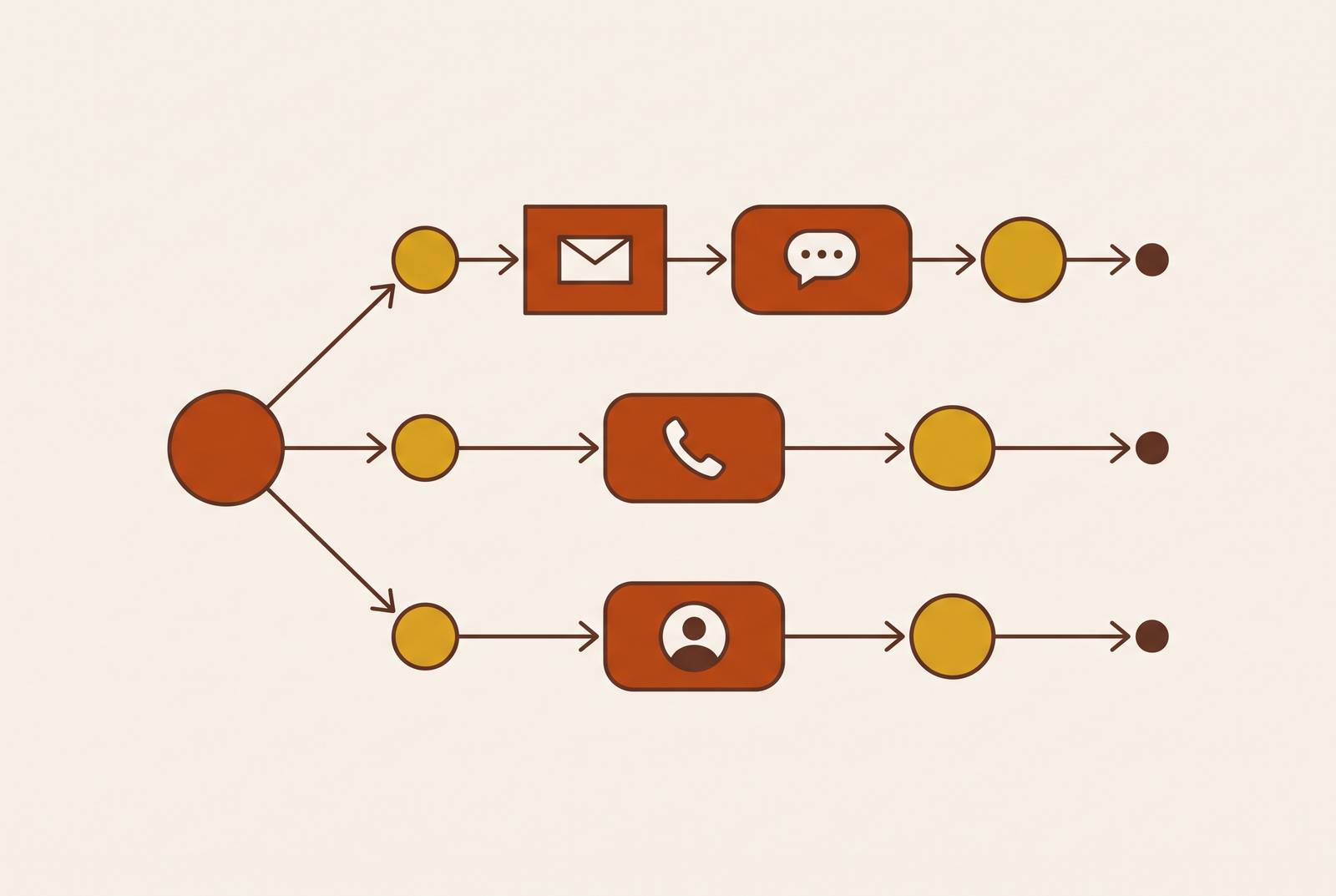
An outbound sequence that adds a LinkedIn touch here and a phone call there, without rethinking how those channels relate to each other, doesn't perform better than email alone. It just produces the same noise across more surfaces. What separates a sequence that converts from one that gets deleted is architecture: the order channels appear in, the gap between touches, and whether each message actually builds on the one before it.
The average B2B buyer gets more than 120 sales-related emails a week, so a marginally better subject line isn't going to move the needle. Three things have converged to make old-style spray-and-pray outreach stop working. Buyers have gotten faster at spotting generic, context-free pitches and faster at ignoring them. AI personalization tools have pushed the baseline up, so relevance that used to differentiate a rep now just gets a prospect to not immediately archive the email. And signal-based timing has split the field into teams reacting to real buying windows and teams still working static contact lists that were exported six months ago. What's replaced the old model is sequences built to compound recognition: each touch on a different channel adds to what the prospect already saw, so by the fourth or fifth contact, the rep isn't a stranger anymore.
Mapping touch count and sequence duration to deal size and buyer type
Most pipeline dies in a gap that's easy to name and hard to fix. Roughly 80% of deals need five or more touches before a prospect engages, but most SDR teams stop reaching out after three. That gap, three touches versus five-plus, is where a huge share of otherwise-viable deals quietly disappear.
Touch count depends on who's on the other end. It's a decision that depends on who's on the other end. For general B2B mid-market outreach, a reasonable baseline runs 8 to 12 touches over two to four weeks, spaced two to three days apart. Structured mid-market programs tend to run tighter: 10 to 12 touches across four to six weeks. Enterprise accounts need more patience, 12 to 18 touches spread across eight to twelve weeks, because there's more than one person in the room. SaaS deals above $10,000 in annual contract value do well starting from a 6-touch multichannel sequence run over 12 to 14 days, while SaaS above $50,000 ACV changes the goal of the sequence entirely: the first ask shouldn't be a demo, it should be a conversation, because at that price point the sequence is opening a relationship, not closing one. Teams competing in crowded segments are pushing further still, running 15 to 21 touches across email, phone, and LinkedIn combined.
None of this is about pestering harder. Longer sequences at higher ACV reflect a longer, more crowded buying committee, one where the champion, the budget holder, and the technical evaluator all need their own version of the same story. Spacing carries just as much weight as count. Touches packed too close together read as harassment; touches spread too thin lose the thread entirely, and the prospect forgets who's writing and why. Two to three days between touches is where most practitioners land, and for good reason: it's long enough to not feel like a shakedown, short enough that the narrative doesn't go cold.
What each channel does in the sequence
Treating email, LinkedIn, and phone as interchangeable slots in a template is the single most common design mistake in outbound. Each channel does a different job, and the sequence only works if that job assignment is deliberate.
Email carries the substance: the proposition, the proof point, the specific ask. It's also the one channel a prospect can go back and reread later, which makes it the right place for detail that a phone call or a DM can't hold. LinkedIn does something else entirely, it keeps a rep's name and face visible in the background so that by the fourth touch, the prospect isn't meeting a stranger, they're recognizing someone. That's a different kind of work running in parallel, not duplicate work. Phone is the one moment in the sequence that can't be faked by text, and it lands best once prior touches have already done the work of lowering the guard that comes with any unscheduled call from an unknown number.
LinkedIn's mechanics dictate a lot of the sequencing logic on their own. The connection request functions as the real opening move, not a courtesy gesture, since the DM that follows an accepted connection is where the actual outreach starts. Some 39% of positive replies come from follow-up messages sent after a connection is accepted, rather than from InMail sent blind. There's also a hard operational ceiling: LinkedIn rate-limits connection invitations at around 100, which caps how many parallel sequences a single rep can realistically run at once and forces some prioritization upstream.
Phone placement follows its own logic too. The best slot for a cold call sits after two or three prior email or LinkedIn touches, because at that point the rep can open with "following up on the email from Tuesday" instead of introducing the company from zero. That single sentence removes most of the friction a cold call normally carries and gives the call an actual reason to exist. Compounding recognition drives this: the email reads as more credible because the prospect already saw the name on LinkedIn, the call feels warmer because the email landed first, and the LinkedIn DM that follows the call gets read because the call just happened.
A concrete 14-day sequence structure for B2B SaaS mid-market outbound
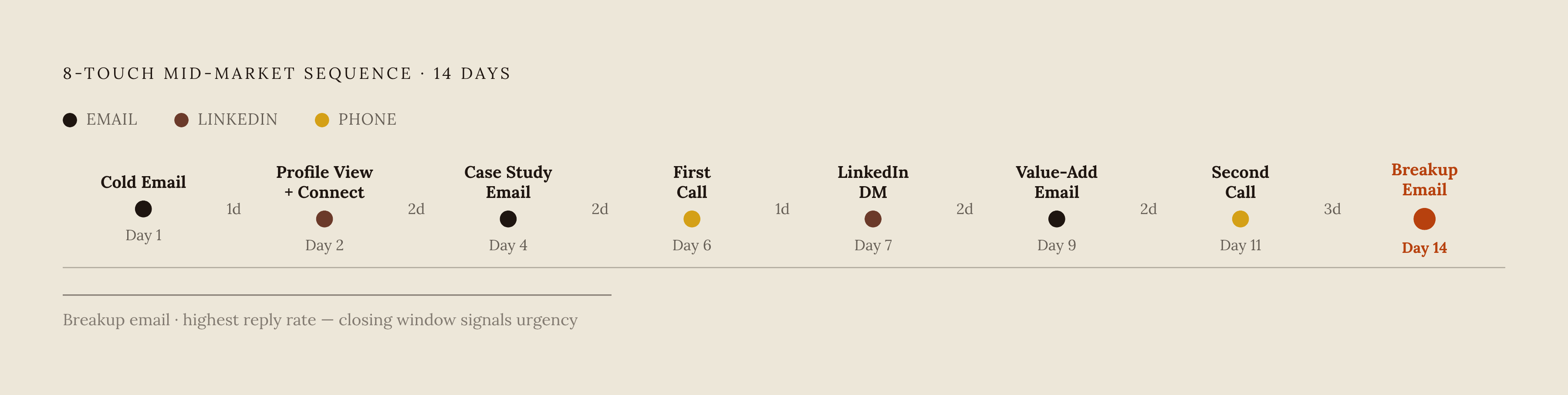
SyncGTM's 2026 B2B Outbound Sales playbook lays out a 14-day mid-market sequence that's become something of a reference model, touch by touch.
A personalized cold email that references a specific pain point or signal, not a generic pitch, opens Day 1. Day 2 follows with a LinkedIn profile view and connection request carrying a short, non-salesy note. Day 4 sends a second email, this one built around a case study or a stat relevant to the prospect's industry. Day 6 is the first phone call, and it references the email sent two days earlier rather than opening cold. Day 7 brings a LinkedIn engagement step, including a DM if the connection went through. Day 9 sends a value-add email focused on relevance rather than another direct pitch. Day 11 is a second call attempt to re-engage the prospect. Day 14 closes the sequence with a final email, a respectful exit that leaves the door open.
That final email, typically the eighth to tenth touch in a longer sequence, often pulls a strong reply rate precisely because it signals the window is closing. The mechanism is straightforward: it creates a real sense that the window is closing.
Each phase of the 14 days does a distinct job. The first four days establish the rep's name and the core premise across two channels before ever asking for time. Days 6 through 9 bring in the phone, the human channel, only after social and email exposure have already done some of the trust-building work, with LinkedIn engagement running in parallel to keep visibility up without adding another message to the pile. Days 11 through 14 close the sequence out: a second call attempt, then a clean, respectful exit that doesn't burn the relationship. Enterprise accounts need a longer version of the same shape, stretched to 12 to 18 touches, with more LinkedIn steps woven between emails and the whole sequence treated as a mapping exercise across several stakeholders rather than a sprint at one contact.
Adding a phone step and LinkedIn follow-through changes the performance math
Email alone tops out at a reply rate of 2% to 3%. That's the ceiling most SDR teams run into and mistake for a personalization problem, when it's actually a channel problem. Email alone tops out at a reply rate of 2% to 3%. The same prospects, contacted through a coordinated sequence that mixes email, LinkedIn, and phone, reply at a rate of 8% to 15%, and that gap is the whole argument for building multichannel.
A single added call attempt moves the number meaningfully, largely because email and LinkedIn inboxes in SaaS are already saturated and a phone call still carries scarcity value. LinkedIn on its own contributes a reply rate around 10%, against a cold email baseline of around 3.43% according to the Instantly Cold Email Benchmark Report. Neither number alone builds a pipeline, but stacked together across a sequence, they produce enough aggregate replies to matter. When the full stack, email, LinkedIn, and phone, runs as one coordinated sequence, fundraiseinsider.com's 2026 outbound playbook documents a lift over email-only campaigns that runs past 287%. Adding a channel produces a different order of outcome, not a marginal gain. It's a different order of outcome.
Signal-based timing changes what the sequence is responding to
The question a sequence answers matters as much as the sequence itself. Most outbound programs are still built around "who should we reach out to this month," which is a targeting question answered by firmographic filters and not much else. Signal-based outbound asks something sharper: who has just shown a sign that they're in an active buying window right now. That reframing is what pushes reply rates above 15% for the teams doing it well.
Concrete and mostly public signals to act on include job changes, hiring surges, funding rounds, technology adoption or churn at a target account, expansion into new markets, leadership changes, product launches, and third-party intent data pulled from outside sources. None of it works, though, without speed. A buying window measured in days doesn't wait for a signal to sit in a CRM for three days before an SDR notices it. Detection and enrichment have to be wired directly into whatever triggers the sequence, not bolted on as a manual review step.
One workflow pattern that shows up repeatedly among teams doing this well: a Tier 1 signal, a pricing page visit, say, fires a Slack alert into a dedicated channel the moment it happens, a round-robin assignment routes it to a rep automatically, and a pre-drafted sequence sits ready so the rep spends about two minutes personalizing it before it goes out. Two minutes, not twenty. The whole point of the workflow is collapsing the time between signal and outreach down to something close to real time.
What message continuity across channels requires
Personalization built on mail-merge tokens, company name, job title, a line pulled from a recent press release, is exactly the pattern buyers have learned to spot and skip past. That kind of personalization scales easily and means almost nothing, because interpreting a signal correctly takes actual thought about the prospect's specific situation, and that thinking can't be templated at volume no matter how good the mail-merge logic gets.
Continuity across channels means each message acknowledges what came before it without simply repeating it. "Following up on the email I sent Tuesday" clears the bar for table stakes, but it doesn't do much work on its own. "Given that you're hiring three SDRs this quarter, the problem I raised in that email is about to get worse" does real work, because it builds on the prior touch instead of restating it. The LinkedIn DM shouldn't be a shorter copy-paste of the email either, it should move the relationship a step further, more direct, less formal. The phone call needs a specific reference point pulled from an earlier touch.
A paradox runs through all of this. AI personalization tools have raised the floor on what counts as acceptable outreach. Surface-level AI copy, the kind that's technically personalized but obviously templated and missing any real interpretation of the prospect's situation, now gets filtered out by human readers and, increasingly, by the AI assistants sitting inside their own inboxes. Research suggests recipients rate AI-assisted messages as sincere far less often than messages with little to no AI involvement. What actually clears that bar is a message anchored to a real, named, verifiable business signal, a specific observation that only makes sense if the rep actually read something about that prospect's situation.
Conditional branching turns a linear sequence into a responsive system
A purely linear sequence has a structural flaw that appears once it's already run: it treats a prospect who opened three emails and clicked a link exactly the same as a prospect who's never engaged once. Both get touch five on schedule, regardless of what either of them has actually done.
Conditional branching fixes that by routing prospects based on their behavior, an email open, a link click, an accepted LinkedIn connection, a connected call, and adjusting what comes next accordingly. A few branches appear across most well-built sequences. When a LinkedIn connection gets accepted, the sequence should move straight to the DM and either skip the next scheduled email or shorten the gap before it. When a prospect opens the same email three times without replying, that's a signal to escalate to a phone call sooner, since someone reading repeatedly but not responding is a different problem than someone not engaging at all, and it calls for a different next step. When a call connects but doesn't produce a booked meeting, the right move is branching into a post-call email track that references the actual conversation, rather than dropping back into the original cold sequence as if the call never happened. When there's no engagement at all through the fifth touch, move the prospect into a lower-frequency nurture track instead of continuing to burn high-effort touches on someone who's shown no sign of interest yet.
The distinction that matters here is between a sequence and a system. A sequence runs on a fixed schedule regardless of what the prospect does. A system reads behavior and changes course, so outbound compounds into pipeline instead of just accumulating as noise nobody opens.
Sources
- Multichannel Outreach Guide (2026 Playbook)
- B2B Outbound Sales Strategy 2026: The Multi-Channel Playbook That Actually Books Meetings | Blog | MarketBetter
- B2B Outbound Sales: The 2026 Playbook for B2B Teams
- Multichannel Outreach Strategy Guide for B2B 2026
- B2B Outbound Sales Strategy: The Complete Playbook for 2026 - Fundraise Insider
- salesmotion.io
- saleshive.com