Outbound Pipeline Building Playbook for SMB Sales Teams
Small sales teams must fix their ICP and data before writing a single email.

Consistent outbound pipeline is possible for a two-person SMB sales team, but only if the work happens in the right order. Skipping a step means every layer built on top of it inherits the crack.
Most SMB teams do the opposite. They write the sequence first, argue over subject lines for a week, then wonder why replies never come in. Highspot's GTM Performance Gap Report found that only 52% of scaled B2B organizations carried out consistently high-performing go-to-market programs over the past year, pointing to departmental silos and weak sales execution as the primary causes. At enterprise scale, that gap gets absorbed by headcount. At SMB scale, there's no absorption. One or two reps run outbound alongside renewals, onboarding calls, and whatever else lands on their desk that week, so a wasted afternoon costs more, proportionally, than it would at a company with a dedicated RevOps function.
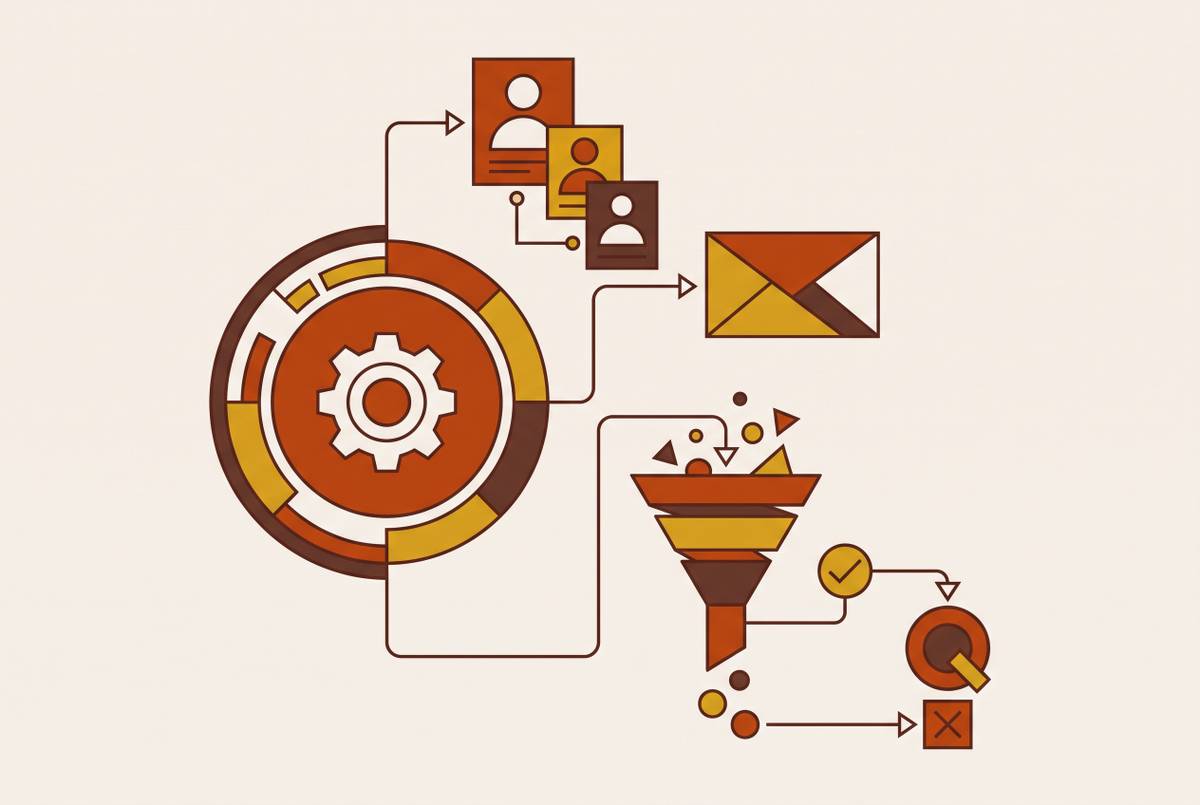
The most common failure is a team that never once pulled its bounce report before deciding the messaging was the problem. It's a team that never once pulled its bounce report before deciding the messaging was the problem. Fix that diagnosis, and the rest of this playbook is really just sequencing: ICP first, clean data second, signal-based targeting third, sequence structure fourth, AI execution layered on top. Each stage makes the next one sharper. Skipping one poisons everything downstream.
Defining the ICP tightly enough that exclusion does the heavy lifting
ICP work is the filter sitting in front of every dollar and every hour spent on outbound, and its job is to say no more often than yes. It's the filter sitting in front of every dollar and every hour spent on outbound, and its job is to say no more often than yes.
That's the part SMB teams underuse: exclusion. A tight ICP doesn't just describe who to chase, it names who to stop chasing, and that second list does more for pipeline quality than any targeting cleverness applied afterward. Lock down the firmographics first: headcount and revenue bands where the product is actually affordable and actually needed, the verticals where the underlying problem is sharp rather than mild, geography and any compliance lines that shrink the addressable list, and the tech stack signals that tell you whether an account is a fit before a rep ever emails them.
Layer behavioral context on top of that. A company posting for its first SDR or sales-ops hire is telling you a sales motion is getting built from scratch, which is a very different conversation than one with an entrenched process. A recent funding round changes what budget exists. A new VP means the incumbent vendor relationships just went soft.
The mistakes are almost always the same three. Teams define ICP as "anyone who could plausibly use this," which isn't an ICP, it's a TAM with better branding. They let the definition drift wider over time to justify a bigger pipeline number, with no evidence the wider slice actually closes. And they keep running the ICP written at launch instead of rebuilding it from the last 90 days of closed-won deals, which is the only data set that tells you who's actually buying now.
The output of this work should be two lists, not one: what to pursue, and what to disqualify on sight. Without that second list, every intent signal from every company looks equally worth chasing, which brings the next problem into focus.
Why contact data decays faster than most SMB teams realize
Contact data doesn't sit still. B2B databases lose somewhere in the range of 25% to 30% of their contacts every year to churn, so a clean 10,000-record list built in January has shed 2,500 to 3,000 usable contacts by the following January, and that's before anyone sends a single cold email. Email addresses decay at roughly 23% to 30% a year. Phone numbers move at about 18%.
The dollar cost isn't abstract. Poor data quality costs organizations an average of $12.9 million a year, and reps lose roughly 500 hours annually, something like 62 working days, just validating and fixing contact records. Running that math on a rep's calendar shows close to a quarter of their selling capacity spent on data hygiene instead of selling. For a two-person SMB team with no data specialist to hand that work off to, that's not overhead, that's the whole outbound motion quietly stalling.
The scale of the underlying problem is wide: the CDP Institute reports that 83% of B2B companies have poor product or customer data, and the CMO Council reports that 62% of marketers say they're only moderately confident (or worse) in their own data and analytics systems. None of this appears as a warning light. Bad data doesn't announce itself; it appears disguised as missed quota, climbing bounce rates, and inboxes that quietly start filtering a domain's mail into spam. IBM research found only 19% of companies believe their own data is AI-ready, which matters directly here: an AI agent drafting personalized outreach on top of a stale contact record is just automating the mistake faster.
For an SMB team, the practical takeaway is blunt. A list built at the start of the quarter is meaningfully worse by the end of it if nobody's maintaining it in between.
Building a clean, enriched contact list through waterfall enrichment
Waterfall enrichment solves a specific problem: no single data provider covers everything, and querying just one puts a hard ceiling on match rate. The logic is simple to describe. If provider one comes back with an invalid or missing email, the system automatically checks provider two, then three, until it lands a valid result, instead of a rep manually re-searching each dead contact by hand.
The gap this closes is large. Multi-source waterfall enrichment gets contact match rates above 90%, compared with 50% to 62% for a single-source database, and that gap compounds directly into deliverability: senders who actively manage list hygiene see meaningfully better inbox placement than senders who don't. Higher data accuracy reduces the cycles reps burn on bounced sends and dead numbers, which reclaims selling time directly. A reasonable target for a well-defined ICP list is 90% email validity or above; drop below that line and bounce rates start actively damaging sender reputation, which suppresses deliverability on every future send, not just the current one.
Look for four things in any enrichment setup: waterfall logic that runs automatically across providers rather than something a rep does by hand, continuous re-enrichment rather than a one-time list pull that decays the moment it's built, verification that happens at the actual send moment rather than only when the list was first assembled, and coverage that includes both email and direct-dial numbers.
Apollo's database, spanning a vast number of contacts and accounts, runs this waterfall logic natively, which matters for SMB teams specifically because it removes the need for a separate data vendor or a RevOps hire to stitch providers together. The data layer and the prospecting layer sit in the same system.
None of this matters, though, without the next layer. A clean list with no timing signal is still a cold list.
Using buying signals to reach accounts when they are in market
Signal-based outbound flips the trigger. Instead of a scheduled cadence or a rep manually scanning a list on Monday morning, the sequence fires because something specific just happened at the account. Research finds signal-triggered sequences beat time-based cadences on both reply rate and time to first meeting, which tracks: reaching someone the week they start actively looking beats reaching them on a schedule built around a rep's calendar.
Signals worth building alerts around for SMB outbound include website visits that show active research into the category, a job change that puts a new VP of Sales or Head of RevOps in place (which resets every incumbent vendor relationship at that account), a funding announcement (budget that didn't exist last month suddenly does), a technographic shift where a company drops or adds a tool adjacent to the category, and hiring patterns, especially SDR or sales-ops postings that signal a motion getting built from scratch.
Growth Unhinged's 2025 State of B2B GTM report ranks intent-based outbound as the #2 GTM channel B2B companies are investing in for 2026, with warm outbound at #5, which shows that the market has already moved past scheduled, spray-and-pray cadences.
The strongest trigger usually isn't one signal, it's a cluster. A funding round plus a leadership change plus a relevant job posting, all at the same account, makes a far stronger case for outreach than any single data point on its own. The same logic applies to closed-lost re-engagement: rather than firing an email on an arbitrary calendar trigger, an agent watches for a cluster of signals, a leadership change, new funding, a champion's departure, and only fires once enough of those converge.
Practically, that means defining upfront which signals count as real for your ICP and which are noise, then tiering them: Tier 1 routes straight to a rep for personalized outreach, Tier 2 goes into an automated sequence with light personalization, Tier 3 gets monitored and re-evaluated rather than acted on immediately. Apollo surfaces buying signals directly alongside the contact record itself, so a rep working a list doesn't have to jump into a separate intent tool to know who's actually in market this week.
Structuring the outbound sequence for SMB sales cycles
Sequence length is where SMB teams tend to swing to one extreme or the other. Either they copy an enterprise cadence wholesale, too many touches spread across too many weeks for a deal that should close in three, or they give up after two emails and a LinkedIn connection request and call the account dead.
The right range for SMB is 8 to 10 touches over 3 to 4 weeks, close enough together to keep momentum without tipping into harassment. Compare that to mid-market and enterprise cadences, which stretch to 12 to 18 touches over 8 to 12 weeks to accommodate bigger buying committees and slower internal approval chains. Running an enterprise-length cadence against a short-cycle SMB deal just burns touches that could've gone to a fresh prospect.
The gap most SMB teams leave open is a persistence gap. Roughly 80% of deals take five or more touches before a prospect actually engages, yet many SDR teams give up well short of that threshold. Disciplined follow-through, on its own, is a competitive edge because most SMB teams give up before persistence pays off, provided the messaging underneath it is decent.
Spacing matters too: emails 2 to 3 days apart for the first two weeks, stretching to 4 to 5 days for later touches, keeps a name visible without flooding an inbox. On channel order, front-load email and LinkedIn in weeks one and two to build some written presence before a phone call ever happens, then bring in calls starting around touch four. Multi-channel sequences see roughly double the response rate of email-only ones. Close the sequence with a clean breakup message rather than letting it just trail off.
Each touch needs its own job. Touch one: short, specific, anchored to the actual ICP fit, why this account and why now. Touches two through four: add something useful, a piece of content, a relevant case study, an actual insight, rather than re-pitching the same thing. Phone touches should reference the prior outreach directly rather than opening cold. The final touches either bring a genuinely new angle or state that this is the last outreach.
Average B2B cold email reply rate is around 3% to 5%, top-quartile campaigns hit 15% or higher, and Instantly's 2026 Cold Email Benchmark Report puts the platform-wide average at 3.43%, with top performers clearing 10%. If an SMB team is at 12% to 15%, that's a strong result worth protecting as-is, not a number to keep tinkering with.
Where AI execution fits into the sequence without replacing rep judgment
There's a real distinction between agentic AI that executes multi-step work on its own (research, drafting personalization, following up, updating the CRM) and rules-based automation that just queues the next step for a human to click through. The first genuinely multiplies what a rep can cover. The second just adds a dashboard.
Sales orgs spend roughly 70% of their time on non-selling activity, leaving only about 28% of a rep's day actually spent selling. AI execution is the lever for shifting that ratio without adding headcount, which for an SMB team with no budget for a third rep is the entire point.
Agents should own the repetitive, always-on work: continuous account research and signal monitoring rather than a rep checking manually once a week, first-draft personalization at the moment a sequence launches (referencing the actual signal that triggered it, not a generic template), follow-up execution on Tier 2 and lower accounts while Tier 1 gets routed to a human, CRM updates logged after every touch so nobody's doing that bookkeeping Friday afternoon, and flagging reply intent so a hot response gets to a rep immediately instead of sitting in an inbox.
Humans keep the decisions that carry real weight: ICP definition and signal tiering, messaging strategy and how the sequence is built, the high-stakes conversations and actual relationship-building, and final review on anything going out to a Tier 1 account before it sends.
Growth Unhinged frames this shift well: moving from plays, individual one-off automations, to systems, AI that watches continuously and acts when a cluster of signals lines up. SMB teams get more out of thinking in systems than in isolated cadences built once and left alone. Apollo's platform is built to support research, list building, and sequencing inside the same platform running the sequence itself, pulling context from its sizable database of contacts, so the execution layer isn't a separate tool bolted onto the prospecting tool, it's one connected system. Teams new to this should start agents on research and CRM hygiene first, then extend send authority to lower-tier accounts once there's trust in the output.
Keeping outreach out of spam: deliverability and compliance basics SMBs skip
Everything above collapses if the email never reaches an inbox. Deliverability isn't a settings toggle checked once, it's an ongoing account of how a sending domain behaves over time, and SMB teams without a dedicated deliverability specialist tend to treat it as an afterthought until bounce rates spike and nobody knows why.
The mechanics that matter start with authentication: a set of standard email-authentication records set correctly on the sending domain are the baseline signal mailbox providers use to decide whether a sender is legitimate. Sending volume matters too, ramping a new domain up gradually rather than blasting a full list on day one, since a sudden spike in volume from an unproven domain reads as spam behavior to receiving servers regardless of what the email says. List hygiene ties directly back to the enrichment work covered earlier: a high bounce rate doesn't just lose that one contact, it damages the sender's reputation broadly, which suppresses inbox placement for every subsequent send from that domain.
Compliance adds a second layer on top of the technical one. Unsubscribe mechanisms need to actually work, opt-out requests need to be honored promptly, and the specific rules governing commercial email vary by jurisdiction, so a business emailing across regions carries different obligations depending on where the recipient sits.
None of this is exotic. It's mechanical, unglamorous, and the exact kind of thing an SMB team without dedicated ops support tends to skip, right up until the moment deliverability quietly falls off and every earlier layer of this playbook, the ICP work, the clean data, the signal timing, the sequence design, stops mattering because the email never lands in front of anyone at all.