Agentic AI Prospecting Workflows for B2B Sales Teams
Autonomous AI agents handle research and outreach while sales reps focus on closing deals.
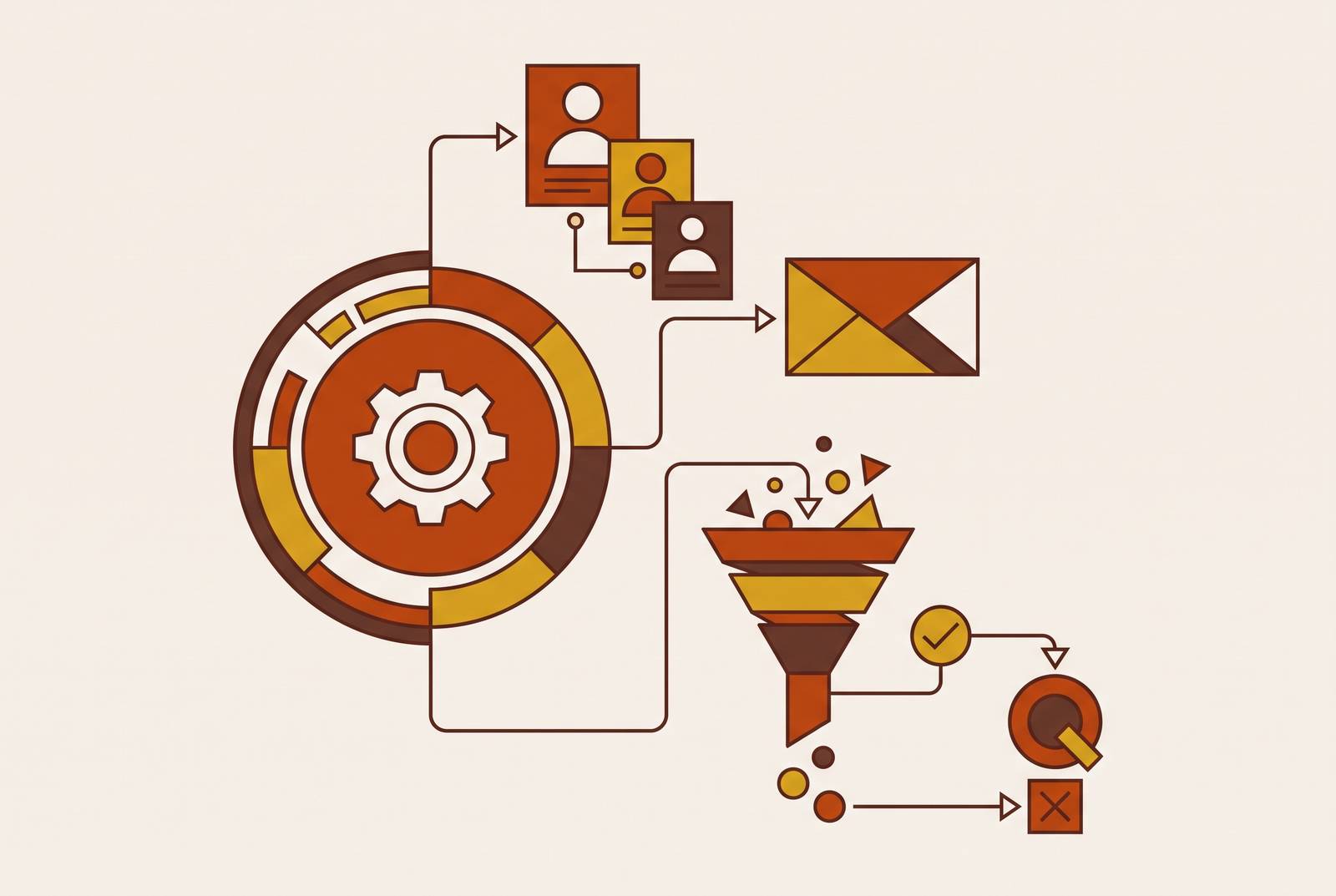
Salesforce's State of Sales survey of 4,050 sales professionals found that 87% of sales organizations now use AI in some form. Deloitte Digital's B2B commerce research, covering 1,060 buyers and suppliers, found that only 24% of B2B suppliers have implemented agentic AI, the kind that runs a workflow on its own instead of waiting for a person to click "send." suppliers and buyers. That gap, 87% down to 24%, is the real story here. Everyone has AI. Almost nobody has handed it the keys.
What "agentic" means in practice, versus automation and chatbots
Old-school automation runs on if/then rules. Send an email every three days. Move a record to a new stage when a field changes. It's a set of instructions, not a judgment call, and it can't distinguish a prospect who's ready to buy from one who unsubscribed two years ago. A chatbot is a step up but still reactive: ask it something about a lead and it answers, but it won't go dig up that lead's funding round on its own, draft an email, and decide when to send it.
monday.com's 2026 analysis breaks the distinction between agentic AI and older approaches into several key traits. It's goal-oriented, working toward a defined outcome rather than following a fixed script. It makes decisions on its own, weighing multiple factors about a prospect and the situation simultaneously. It reads signals from the environment, responding to what a prospect actually does rather than a predetermined schedule. It learns continuously, updating its approach based on what's working without someone manually rewriting the playbook. And it adapts mid-sequence based on what just happened, shifting channel, message, or timing accordingly.
Picture one loop end to end. An agent flags a high-value account because of firmographic fit plus a spike in website activity. It researches an expansion announcement, drafts a personalized email referencing it, and sends it. The prospect opens the email but doesn't reply. Two days pass, and the agent switches to LinkedIn with a different angle. The prospect engages there. The agent sends a calendar link, checks the rep's availability, and pulls in a relevant case study before the meeting happens, all without anyone approving a single step along the way.
That's the real dividing line. Agentic AI doesn't assist with prospecting, it does the prospecting, and a human only shows up once there's an actual conversation worth having. That matters because reps currently spend a large majority of their time on things that don't generate revenue: researching accounts, updating CRM fields, writing follow-ups, hunting for information scattered across five different tools. Faster automation shaves time off that overhead. Agentic systems are the only category built to remove it structurally, not just speed it up.
Data quality and agentic workflow success
Teams that turn on an agentic workflow against a dirty database usually misdiagnose the failure. They blame the subject lines. They rewrite the offer. They tweak the sequence cadence for the third time this quarter, and nobody opens the bounce report, so the problem stays invisible until it appears as a missed number at the end of the month.
The math on decay alone should be alarming. B2B contact data decays meaningfully every month, compounding into significant degradation over the course of a year. Email addresses and phone numbers both go stale at a substantial rate each year. A list that was clean in January is meaningfully rotted by the time Q3 starts, and an agent working off that list is just running bad outreach faster than a human ever could.
The cost isn't abstract, either. Poor data quality carries substantial costs for organizations, and sales reps burn a significant number of hours annually just validating and fixing contact records. That's a meaningful share of a rep's entire selling capacity spent cleaning up a database instead of selling into it.
Coverage matters as much as freshness. A single data provider often misses a substantial portion of the contacts a team is looking for. Waterfall enrichment, stacking multiple providers in sequence until one of them gets a match, meaningfully improves find rates and reduces bounce rates compared to unvalidated lists. A well-built ICP list should reach a high email validity threshold before an agent is allowed near it; low validity starts eating away at domain reputation with every send. The cadence that keeps this in check involves regular checks on active pipeline, periodic passes on the broader CRM, and full re-enrichment at intervals. If a team goes more than 90 days without a pass, the system starts feeding stale records into something running at machine speed.
Apollo's approach here is built on a database of a substantial number of contacts and a large number of accounts, refreshed continuously with ongoing enrichment underneath it. That's the layer everything else in this article sits on top of. Skipping it means an agentic system automates noise instead of prospecting, just more of it, faster.
Stage one of the agentic workflow: ICP definition, account identification, and signal-based list building
The old way: a rep filters a database by industry and headcount, exports a CSV, and works the list top to bottom until it's exhausted. The trigger for that work is a date on the calendar, not anything happening in the market.
Signal-based outbound flips that. The trigger becomes a behavior or an intent signal, such as a visit to the pricing page, a new VP hired, a funding round closing, or a shift in the prospect's tech stack. That single architectural change is a big part of why signal-based systems are built to outperform static list-based ones. One vendor now lets a rep type a plain-language description, "manufacturing companies in the Midwest with 50-200 employees that recently hired a VP of Sales," and get back a matched list, no complex filter-building required.
At this stage, the agent is doing four things without waiting to be asked. It watches accounts against the defined ICP around the clock. It catches trigger signals, funding, hiring, tech changes, site visits, and flags which accounts are in-market right now, not six months from now. It ranks accounts by signal strength and fit, not alphabetically and not just by whoever owns the territory. And it runs enrichment through that waterfall logic before any message goes out.
Website visitor identification plugs into this as another signal source. The vast majority of B2B website visitors never identify themselves, but identification tools can resolve an IP address to a company profile, showing which pages got visited, how long someone stuck around, which product pages they lingered on, and feed that straight into the prioritization queue. Identification rates on B2B traffic vary, and that gap separates a cold list from a list of companies actively looking at what's being sold. Put together, AI-powered search, signal detection, and waterfall enrichment stop being three separate tools a rep bounces between and become one continuous stage that refreshes itself.
Stage two: autonomous research and the construction of personalized outreach context
Ask any rep how long real research takes per prospect, checking LinkedIn, the company site, recent news, digging through CRM history, and the honest answer eats a meaningful chunk of the day. Multiplying that across a full list makes it obvious why so much outbound reads like it was written for nobody in particular.
An agent running this stage pulls the firmographic basics (headcount, industry, tech stack, growth stage), then scans for trigger events such as a funding round, a new executive, a product launch, or a mention in the trade press. It reads the prospect's LinkedIn activity and the company's open job postings for hints about where they're headed strategically. It checks CRM history so a previously touched account gets treated with that context instead of as a fresh cold start. Then it builds a brief, specifying the hook to use, the value angle that fits, and which channel to try first.
The payoff appears in reply rates. Autobound.ai found that AI-driven personalized emails get five times the reply rate of standard outreach, and the reason tracks: research is what makes personalization mean something, rather than just swapping in a first name and calling it done. More than 80% of B2B sales teams using AI report measurable revenue growth, compared to roughly two-thirds of teams still prospecting by hand, and the gap widens most for teams using AI to actually research and personalize rather than just send messages faster.
A team still has to define its ICP, its value proposition, and its playbook, so human judgment still matters. The agent builds the context, but a team still has to define its ICP, its value proposition, and its playbook, and approval gates can be set up so a rep reviews anything going to a high-value account before it sends. Apollo's context engine learns each customer's ICP and playbook over time, so the research it produces gets sharper the longer the system runs, which is the compounding effect that makes stage one and stage two worth connecting rather than running as separate tools.
Stage three: multi-channel sequence execution and adaptive follow-up without manual task queues
Sales engagement platforms built the last generation of this category around task queues: a rep logs in, sees a list of calls and emails due today, and works through them one by one. Sales engagement platforms got AI features bolted on over time, but a human is still the one executing each step.
An agentic model replaces the fixed cadence with a live decision. The agent picks the channel, the timing, and the message variant based on what the prospect is actually doing. Email opened, no reply? Switch to LinkedIn. LinkedIn connection accepted, still no response? Queue a call for whatever window tends to convert for that account tier. None of it waits on a rep checking a dashboard.
Coordinating across channels means treating each one for what it's good at. Email carries the first touch and most of the follow-up, but deliverability has to be built into the platform itself, sending limits, domain reputation, unsubscribe handling, not stapled on after the fact. LinkedIn touches, connection requests, InMails, profile views, act as warm signals the agent times against the email cadence. Phone gets reserved for the accounts worth a dialer, and conversation intelligence, in the way Nooks approaches it, reviews call performance and flags objection patterns without someone listening back to every recording. Timing itself gets tuned to when a given prospect tends to actually engage, rather than a batch send at 9 a.m. because that's when the sequence was scheduled.
The adaptive part is what separates this from automation dressed up in new language. When a prospect opens an email and goes quiet, the agent decides on its own what happens next, a new angle, a different channel, or a pause, based on the account's tier and history. Teams running AI-driven prospecting are reclaiming 4 to 7 hours per rep per week that used to go into research and list-building, and agentic execution adds to that by taking manual task processing off the table too. Apollo runs sequencing, dialing, and LinkedIn outreach inside one system tied to the same data and signal layer, so a rep isn't the glue holding four separate tools together. None of this works without compliance built in from the start, GDPR, CAN-SPAM, do-not-call handling, because a system sending at this volume without those guardrails will damage a domain's reputation fast and create legal exposure that's hard to walk back.
Stage four: CRM synchronization, pipeline handoff, and the feedback loop that makes the system smarter
Every rep knows the drill: after each call or email, go log it. Update the stage. Write the notes. It's tedious. It's a major reason CRM records go stale in the first place, and it's a big piece of that 70% non-revenue-time figure from earlier.
An agent handling this stage logs every touchpoint straight to the record, email sent, opened, replied to, calls connected, LinkedIn responses, without a rep typing a word. It updates contact and account fields as new enrichment data comes in during the sequence. When an account crosses a defined threshold, a booked meeting, a positive reply, a demo request, it hands the account to an AE along with a briefing: engagement history, company context, relevant case studies already pulled together. Accounts that go cold don't get archived and forgotten, they get flagged for a different approach later.
The feedback loop is where the system actually gets smarter rather than just faster. Every outcome, which angle got a reply, which signal preceded a booked meeting, which channel worked best for which segment, feeds back into how the agent targets and personalizes going forward, without anyone manually rewriting the playbook. McKinsey's 2026 B2B Pulse Survey found that growth leaders embedding AI directly into core workflows point to seller efficiency as the top benefit (59% of respondents) followed by better customer experience (53%). Financial services firms that rebuilt prospecting and relationship-management workflows around agentic AI saw 3 to 15% higher revenue per relationship manager and 20 to 40% lower cost-to-serve.
Apollo closes this loop by keeping deal stages, notes, and activity data in the same system as the prospecting and outreach layer, so nothing gets lost translating between a sequencer and a separate CRM through a webhook. The platform's value compounds with time in use: early sequences run on the ICP definition alone, but later ones carry forward accumulated signal correlations, reply patterns, and coaching data that's already baked into how the system decides what to do next.
Structuring the agentic stack: growth leaders versus teams assembling point tools
Most teams still stitch together a data provider, an enrichment tool, a sequencer, a dialer, some CRM automation, and an analytics dashboard on the side. In that setup, the rep becomes the integration layer, logging into five systems every Monday, pulling lists, pasting them into a sequencer, writing messages by hand, then checking three other tabs to see who responded. That's the exact overhead agentic AI exists to remove, and running six point tools side by side just recreates it with extra software licenses attached.
Growth leaders are consolidating instead: one system for data and signals, one for research and personalization, one for execution across channels, and one feedback loop tying it all back to the CRM. The fewer handoffs between systems, the less gets lost, and the faster the compounding effect described in the earlier stages appears in the pipeline. The 87%-to-24% gap between AI adoption and agentic adoption isn't a technology problem. IBM's State of Salesforce 2025-2026 research, covering more than 1,200 customers, found 53% cite poor data quality as the top barrier to adoption, not cost, not access to tools. The teams closing that gap are the ones that fixed the data first, then let the workflow run. They're the ones that fixed the data first, then let the workflow run.