Recruiting Workflow Automation With AI Prospecting Tools
AI agents now handle sourcing legwork, letting recruiters focus on strategy and judgment.
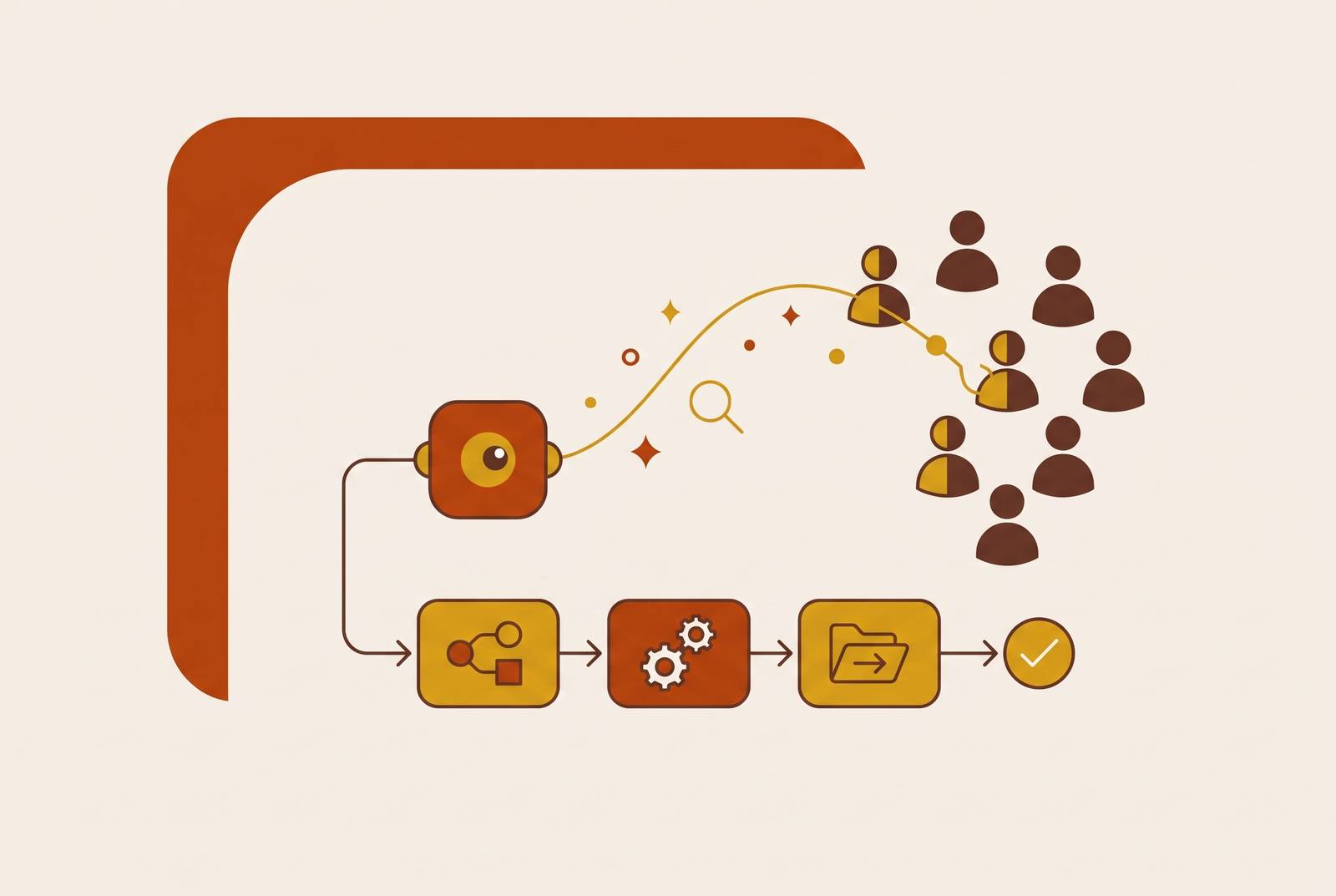
Recruiting workflow automation with AI prospecting tools changes both who does the work and how quickly it gets done. As sourcing, outreach, and scheduling become a connected process, recruiter effort shifts from manual execution to strategic oversight. The best setup combines autonomous execution with clear hiring criteria, data people can trust, and human judgment where decisions shape the results.
Why outbound sourcing has become the primary hiring channel, not a supplement to inbound
Inbound recruiting faces a widening gap between application volume and useful signal. As inbound pipelines are gamed, more applications do not necessarily produce a stronger candidate pool. Sourced candidates are hired at a dramatically higher rate than inbound applicants, despite representing a small fraction of applications.
That asymmetry changes the purpose of the funnel. Recruiters spend less time working through applications and more time finding and talking to people who fit the role before they apply anywhere. Outbound therefore moves from a supplementary activity to the core hiring channel. Candidate discovery, profile research, outreach, follow-up, and scheduling become recurring work across active roles, and the volume required to perform those tasks consistently makes manual execution unsustainable.
What the traditional sourcing workflow actually costs in recruiter time and what breaks first
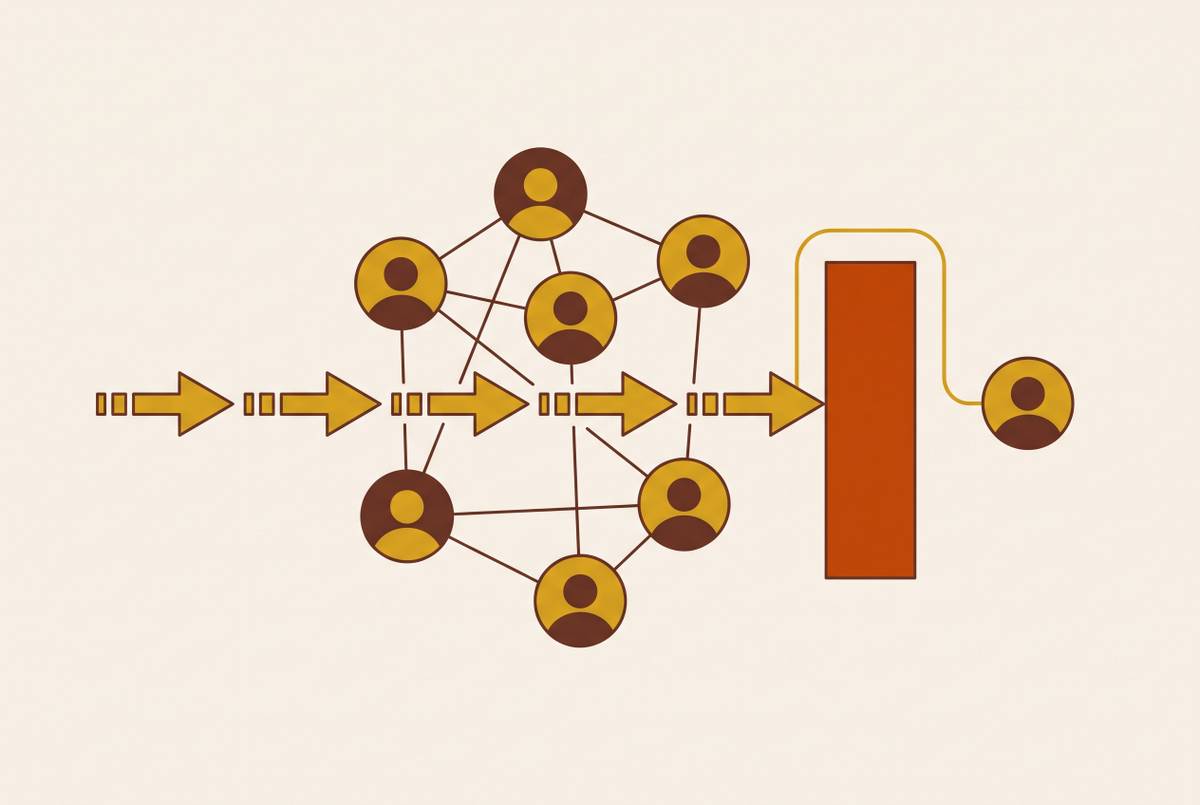
Manual sourcing depends on a recruiter moving every stage forward. The recruiter searches, reviews profiles, builds a list, writes messages, tracks responses, follows up, and schedules conversations. Each stage waits for human initiation. Talent acquisition professionals can spend a significant portion of the working week sourcing for a single role before relationship-building or interviewing begins.
Consistency is the first thing to break. Personalization weakens as outreach volume rises, follow-up cadences slip, and discovered profiles remain uncontacted. Data then becomes a second constraint because manual work provides no reliable mechanism for detecting changes in candidate availability. Someone previously looking may now be settled, while a formerly passive candidate may be open to an approach. Faster searching alone cannot repair a workflow whose later stages still depend on the same overloaded person.
How AI tools redesign the sourcing workflow at the mechanical level
AI sourcing operates through three connected layers. Natural language processing reads resumes, job descriptions, and public profiles for what they mean. A Boolean search for “Python developer” can miss someone whose profile says “built data pipelines in Django and Flask.” NLP can recognize the relevance of that experience.
Machine learning then uses patterns in past hiring data to score and rank candidates. That layer prioritizes the pool rather than merely enlarging it, although its usefulness depends on the patterns and data available. Agentic systems carry out several steps on their own, without a person having to start each one. Together, these layers allow monitoring, discovery, engagement, and tracking to run in parallel across active roles.
The agentic shift — when AI stops waiting for the recruiter to click next
The decisive change in 2026 is a different relationship between recruiter and system. Earlier AI-assisted sourcing still left the recruiter managing a queue, reviewing candidates, approving outreach, and triggering follow-ups. Agentic systems chain sourcing, outreach, and scheduling without per-step human approval.
hireEZ announced on August 18, 2026 that it had rebuilt itself from the ground up on agents. SeekOut appointed Sean Thompson as CEO, effective May 4, 2026, to lead what it called “the agentic AI recruiting revolution.” These developments position agents as a platform-level commitment. fillmore by Metaview makes that model concrete through autonomous outbound sourcing, outreach, and scheduling, with pricing per successful hire.
That pricing reflects a system organized around delivering an outcome. While the recruiter works elsewhere, an agentic workflow can mine profiles, craft and send outreach, and book interview slots. The recruiter’s main interaction becomes review. Recruiters set parameters, review shortlists, work through edge cases, and adjust criteria in place of moving each candidate through the process by hand.
What the end-to-end workflow looks like when these tools connect across the full funnel
A connected funnel begins with shared hiring criteria. Metaview’s AI Sourcing agents use job descriptions, natural-language briefs, and hiring manager feedback to find and rank candidates, while Application Review prioritizes inbound applicants. AI Screening agents hold conversations tailored to each candidate, and the AI Notetaker records structured evidence and creates scorecards. Supported ATS connections include direct scorecard submission for Ashby and Lever and partial autofill for Greenhouse.
Metaview’s emnify case gives a concrete view of the reported outcomes. Matthias Schmeisser, VP, People & Organisation, saw a 46-point improvement in candidate NPS and a reduction in interviews per hire from 60 to 31.5. Assessment write-ups also took much less time, freeing up time each week.
Findem illustrates a related route through platform consolidation. Its 2025–2026 acquisitions of Getro and Glider AI support a pipeline in which candidates can be sourced, assessed, and verified before reaching a hiring manager. In autonomous outbound workflows, scheduling completes the connection from discovery to interview. Recruiter attention consequently shifts from coordination between stages to role definition, hiring manager alignment, offer strategy, and final candidate evaluation.
How the recruiter's role changes when execution is handled and oversight becomes the job
Searching, messaging, and scheduling give way to defining criteria, interpreting recommendations, managing hiring manager relationships, and making final calls. The objection that AI necessarily removes judgment confuses execution with decision-making. Removing routine coordination creates room for recruiters to exercise judgment more consistently, provided the workflow preserves their authority.
The required skills become practical and specific. Precision in role definition turns a general hiring request into criteria the system can use. Feedback fluency means expressing approvals, rejections, and adjustments in ways that shape agent behavior over time. Relationship depth becomes more consequential as candidate-facing time concentrates on conversations that influence acceptance decisions. Oversight is therefore active work, requiring recruiters to understand both the role and the recommendations produced against it.
Where AI sourcing tools still fail and why data quality is the first constraint
Stale data is often the first failure point. A candidate who has not updated LinkedIn or GitHub in 18 months appears as they were at their last update. Platforms including hireEZ, SeekOut, Gem, Findem, and Fetcher share this exposure when their open-web data goes stale. Underlying data freshness can therefore differentiate tools even when their search capabilities appear similar.
A tool may surface a thousand qualified engineers without knowing that an organization’s strongest backend hires historically came through referrals. It optimizes for signals it can read. Historical hiring data can also reproduce bias across automated decisions, while an apparently objective ranking obscures unfair patterns. Removing names and gender fields does not eliminate this risk because other data can act as proxies.
Outreach creates a separate candidate-experience risk at scale. Messages that feel templated or irrelevant can damage the employer brand even when delivery is efficient. More activity is not automatically better engagement. Closing the gap between finding profiles and understanding how an organization hires requires deliberate configuration, feedback loops, and recruiter oversight, rather than an assumption that autonomy supplies missing context.
The compliance layer that agentic recruiting makes impossible to ignore
A federal judge expanded a case to include applicants screened by HiredScore AI, a Workday tool. An earlier related ruling held that Workday could be considered an employer’s “agent” when performing traditional hiring screening functions, exposing employers to liability for automated decisions. Agentic systems sharpen that issue because reducing human initiation is central to their operating model.
The overlapping rules create distinct operational obligations. Colorado Governor Jared Polis signed SB 26-189 on May 14, 2026, repealing and replacing SB 24-205 with a narrower regime centered on “covered automated decision-making technology.” California requires someone with the training and power to override employment-related automated decisions to provide meaningful human oversight, along with detailed records kept for at least four years. It also makes proactive bias testing relevant evidence in discrimination cases without mandating that testing.
The EU AI Act classifies recruitment systems as high-risk, with documentation and transparency requirements distinct from U.S. state rules. At the federal level, the EEOC has affirmed that AI selection procedures can create disparate impact liability when outcomes disproportionately exclude protected groups and employers cannot demonstrate job-relatedness and business necessity. To meet these separate requirements, teams need to plan for reviewers who have real authority, can understand and override decisions, and keep the records required where the rules apply.
How to evaluate and build an AI recruiting stack that matches your workflow's actual shape
Tool evaluation starts with the constrained workflow stage. A team struggling to discover candidates needs a different tool from one overwhelmed by screening or scheduling. Category fit comes before feature breadth. Pricing and ratings provide additional context, but they do not establish whether a product addresses the team’s actual bottleneck.
For connected workflows, Metaview covers sourcing, application review, screening, and interview intelligence, with a free Notetaker tier. Recruiterflow is an AI-native platform for recruitment firms, with AIRA agents for candidate matching, job change alerts, and note-taking, and a G2 rating of 4.6. Bullhorn combines staffing-focused ATS and CRM functions with embedded AI and automation.
For autonomous outbound work, fillmore offers sourcing through scheduling with per-successful-hire pricing, while hireEZ provides agent-based passive-candidate sourcing with quote-based pricing. Betterleap combines automated sourcing, email outreach, and pipeline management for agencies, with custom pricing and a G2 rating of 4.5. Specialized discovery has a different emphasis. SeekOut targets specialized and cleared talent, Eightfold combines skills-based matching with internal mobility, and Juicebox supports natural-language candidate search without Boolean expertise.
Communication and assessment bottlenecks call for other capabilities. Paradox’s Olivia supports conversational AI for high-volume hourly and frontline hiring, while Puck provides AI phone screening for inbound-heavy hiring. GoodTime coordinates multi-stakeholder interview panels with quote-based pricing, and Hirevire offers asynchronous video screening without scheduling. Textio addresses job description bias interruption and diversity scoring, with a G2 rating of 4.2.
Budget and operating scale also shape the choice. Manatal offers pipelines that agencies and smaller teams growing fast can customize from $15/user/month, while Truffle brings together resume screening, one-way video interviews, and assessments for small businesses that hire for the same roles again and again. Truffle offers a free trial without a card and has a G2 rating of 5.0. A best-of-breed stack offers specialization at the cost of integration work, while consolidation favors workflow continuity. Neither approach removes the need to evaluate audit trails and override mechanisms against every jurisdiction where the team hires.
What to get right before deploying AI in your recruiting workflow
Before deployment, teams should define what a good hire looks like precisely enough for the system to apply that definition across candidates. ATS and CRM data also need cleaning where records are stale, inconsistent, or incomplete, because poor inputs weaken recommendations. These tasks establish the basis on which automation will operate.
Someone needs to be in charge of oversight before the system goes live. That person must be trained, empowered to override decisions, and positioned to document the review process. Bias testing should precede broad rollout, using historical hiring data to examine whether outcomes vary by protected-class proxies. Applicable legal obligations need separate consideration rather than an assumption that one test satisfies every jurisdiction.
Recruiter onboarding must also teach feedback alongside navigation. Teams need to understand how approvals, rejections, and adjustments influence agentic systems, because those signals shape future outputs. The strategic decision is whether to automate isolated tasks or redesign the workflow around AI execution and human judgment.