LinkedIn Prospecting Automation Limits and Workarounds
LinkedIn's connection limits depend on account reputation, not your subscription plan.
The specific number of connection requests an account can send in a given week is never published anywhere, and no support document states it plainly. Teams that treat the ceiling as a fixed allocation tied to their plan level are already operating under a misunderstanding that leads directly to restrictions.
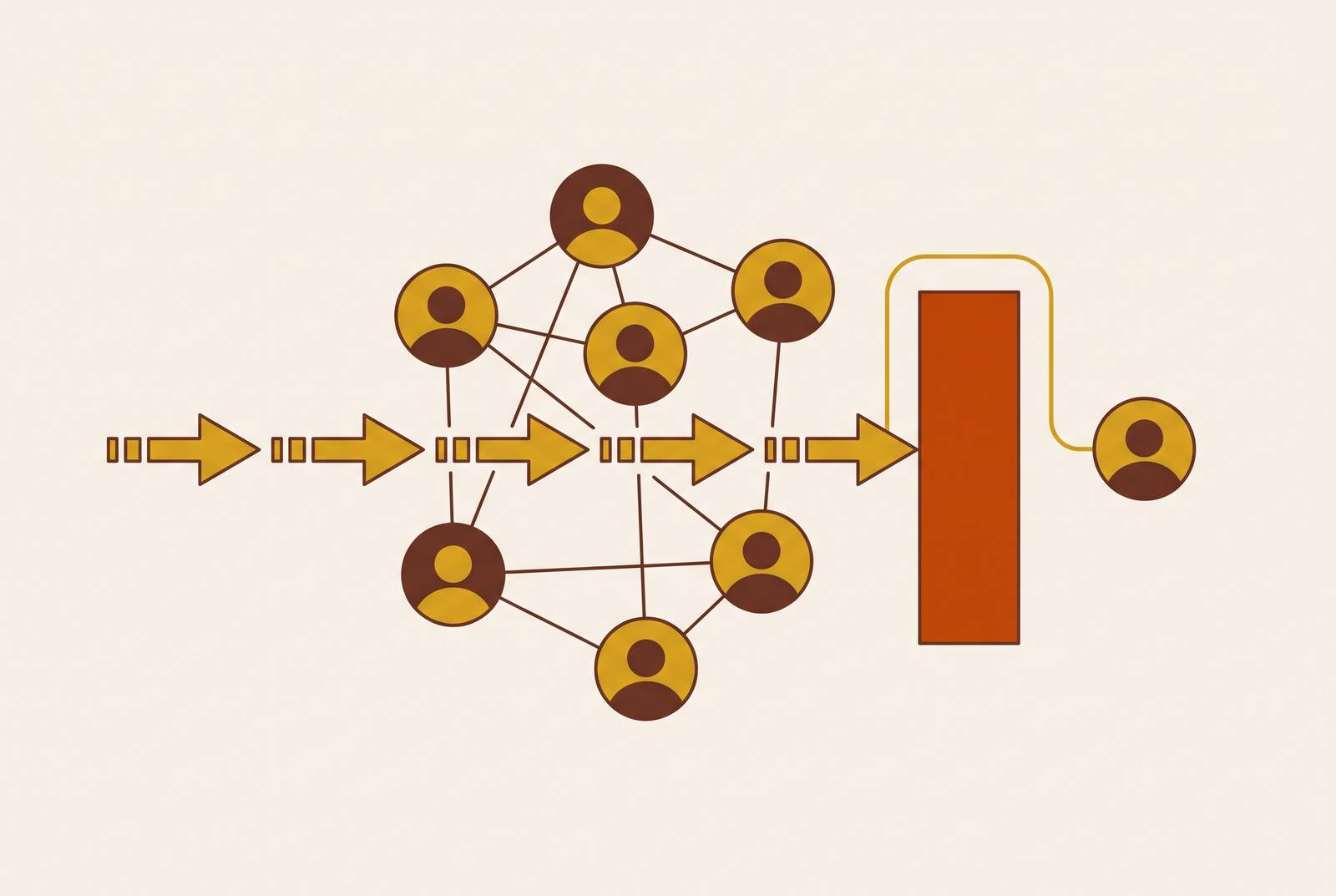
The real ceiling is an output of a behavioral model, not an input from a pricing page. Three variables govern where an account sits on the gradient: its age and history, the consistency of its activity, and its connection acceptance rate. Sales Navigator and Premium subscriptions unlock InMail credits and deeper search filters, which are genuinely separate mechanisms, but they do not raise the weekly allowance for connection requests. YALC's 2026 limits guide describes the classifier as watching three things at once: the queue, the pace, and the pattern. If any one of those drifts from what a normal human account produces, throttling begins before any warning appears.
This distinction matters because it changes what an operator optimizes for. The number is an effect, not a cause. Every practical decision about tools, warm-up, targeting, and sequencing flows from that fact.
The specific numbers the classifier uses as trip wires
The reputation gradient produces a range of weekly ceilings that shift with account maturity, and operators work from observed thresholds rather than official ones. New accounts sit in the lower zone. Established accounts with consistent history and healthy acceptance rates typically reach around 100 connection requests per week. Highly trusted accounts, those with strong engagement and long clean histories, may approach 200. Zeliq's 2026 automation guide names the mechanism directly, calling it the Reputation Gradient and describing how limits vary based on account age, activity history, acceptance rate, and an internal reputation score.
Three separate limits operate independently, and breaching any one of them can trigger a restriction on its own. The weekly invite cap is the most visible, but the pending queue is a distinct hard ceiling on the total number of outstanding, unaccepted requests an account can hold at any moment. Exceeding the daily messaging range is lower risk than breaching the invite cap, but it still generates classifier signals that accumulate over time.
The rolling seven-day window is where even disciplined teams make structural mistakes. Teams that plan against a Monday-to-Sunday cadence frequently overshoot without realizing it, because they count capacity that has already partially recovered from earlier sends. The window does not care what day it is.
The detection system is not a volume counter. The classifier watches several signals simultaneously: action velocity and burst patterns, timing regularity, acceptance and reply rates, browser fingerprinting, IP and geographic consistency, API call patterns, and message similarity across sends. PhantomBuster's guide adds the specifics practitioners actually encounter: robotic timing, repetitive outreach flows, low response rates, and running multiple tools in parallel on the same account.
Recipient behavior is a classifier input, and it is one of the most damaging because the operator cannot directly control it. When many requests are ignored, left pending, marked as spam, or flagged with "I don't know this person," LinkedIn reads the pattern as a targeting failure. The tool being used matters less than the behavioral signature it leaves, and nothing leaves a worse signature than a list that generates silence.
Sign-in anomalies form a separate risk vector that compounds everything else. LinkedIn records location, IP, browser, and device for active sessions. Country-hopping VPNs and shared credentials introduce signals that the classifier checks independently of volume, which means an operator can breach no numeric limit at all and still draw scrutiny because the account's sessions look geographically unstable.
The March 2026 action against HeyReach marks a strategic shift in enforcement, from warning individual users to removing vendor infrastructure. On March 25, 2026, LinkedIn removed the HeyReach company page and restricted the personal profiles of its CEO, CTO, CRO, and CMO. The software itself was not shut down, and customer campaigns continued running. What stopped was the vendor's visible presence on the platform.
The instructive detail is that many of the affected users were operating within the tool's own recommended settings. LinkedIn demonstrated that it can identify the tool being used and act at the vendor level, which means every tool running on the same architecture carries shared structural risk regardless of how conservatively any individual account behaves. After the action, HeyReach kept its LinkedIn functionality intact while its company page and founders' profiles remained removed, a signal about where the enforcement actually landed.
The strongest objection to treating this as a turning point is that it was exceptional. Risk does not attach to an individual account alone. It scales with the vendor's footprint. The more accounts share an infrastructure pattern, the more data LinkedIn has to identify that pattern, and the more likely identification becomes.
The genuine risk difference between browser extensions, cloud tools, and API access
Tool architecture is the single most consequential variable in restriction risk, but the choice is not between safe and unsafe. Nothing in the tool landscape is fully sanctioned except official API access and manual use.
Browser extension tools, Octopus CRM, Dux-Soup, and Waalaxy in its free mode are the examples practitioners name, run inside the user's active LinkedIn session. But the HeyReach case is the strongest objection to a simple "cloud is safest" consensus: the architecture LinkedIn actually targeted was cloud-proxy. Detection accumulates across the vendor's user base over time.
Official API access is the only category LinkedIn treats as fully authorized. Platforms like Overloop, which combines multi-account LinkedIn with AI lead generation across a large B2B database and a unified LinkedIn and email inbox, represent an approach designed to reduce local-footprint risk while staying within structured limits. The no-tool option is also a documented response: pivoting outreach execution to email after identifying prospects on LinkedIn, as Zeliq does, removes the LinkedIn dependency for the riskiest part of the sequence entirely.
Account warm-up and pacing as the foundation of any compliant setup
No tool architecture compensates for an account the classifier has never seen behave normally. Skipping warm-up is one of the most common reasons accounts face early restrictions, and the logic is straightforward: a new or dormant account has no acceptance signal and no organic activity to serve as a baseline. Any automated pattern reads as suspicious immediately because the classifier has nothing human to compare it against.
The protocol YALC's 2026 guide specifies is two to four weeks of manual warm-up before a sequencer is switched on. During that period the operator posts content, accepts inbound invites, replies to messages, and engages with posts. Profiles that are new or have low connection counts should start at a low daily request volume and ramp up gradually. Recovered and dormant accounts follow the same logic as new ones: a long-quiet account has no recent behavioral baseline and looks fresh to the classifier regardless of how old it is.
Pacing is an ongoing discipline, not a setup step. Sending at the exact same minute every hour is an explicit scripted-behavior signal that PhantomBuster's guide names directly. Withdrawal does not restore the active weekly allowance, so the discipline is about clearing the queue, not recovering capacity.
How SSI score, acceptance rate, and list targeting shape the real ceiling
The gradient does not freeze after warm-up. An account's real weekly ceiling rises or falls continuously based on the signals it keeps generating, and the most important of those signals is acceptance rate. List targeting is therefore an account health decision before it is a campaign optimization.
Social Selling Index functions as a proxy for the classifier's view of an account. LinkedIn grants higher effective limits to accounts with strong SSI scores, which are built through establishing a professional brand, finding the right people, engaging with insights, and building relationships. Zeliq's guide describes a temporary suspension, a lockout of seven to thirty days, as "often the last warning before deletion."
The connection request is the highest-risk action in the entire system because it is where acceptance rate is generated or destroyed. A common objection is that teams can compensate for a weak list with personalized messaging. The list must be qualified before the send, because no amount of message craft changes what the recipient does with the request itself.
Why volume as a strategy is losing ground to signal-triggered outreach
The 2024 Volume Tax algorithm changed the economics of blast outreach, and the narrowing practical safe ceiling finished the argument. Volume-based automation no longer produces better pipeline outcomes than signal-triggered automation, and it now costs significantly more in account risk. The acceptance rate gap between legacy blast automation and signal-triggered outreach is large enough to define two different categories of outreach, not better and worse versions of the same thing.
Signal-triggered architecture changes what the automation responds to. Four trigger classes define the modern form. Event triggers fire on CRM stage changes and form submissions, intent signals from inside the seller's own systems. Timer triggers handle follow-ups a set number of days after a connection is accepted, sequenced continuation rather than cold volume.
The structural ceiling remains: a single account doing signal-triggered outreach has a hard monthly limit on new prospects reachable. Running several accounts within their individual limits multiplies reach without breaching any single account, provided the tool enforces per-account limits and manages the stack. Platforms like Overloop are built around this model, combining multi-account LinkedIn, AI lead generation from a large B2B contact database, and unified LinkedIn and email sequencing in one workflow, so teams scale without concentrating risk on a single account or channel.
The per-account weekly ceiling is a hard constraint that no workaround removes. The teams generating the strongest pipeline outcomes are therefore the ones treating LinkedIn as one channel in a coordinated sequence rather than the sole channel for outreach execution. Multi-channel response rates substantially outperform single-channel LinkedIn-only outreach, and the combination multiplies touchpoints without multiplying LinkedIn account risk.
The functional sequence is specific: connect on LinkedIn, follow up by email if there is no reply, then bounce back to LinkedIn if the email gets no response. Overloop's 2026 automation guide positions this unified LinkedIn and email workflow as the core of its platform design, and the performance margin is measurable. The logic is structural: each channel carries independent risk budgets, so switching channels extends the conversation without drawing further against the LinkedIn account's gradient.
Within LinkedIn, several platform-permitted features extend reach without touching the connection request cap. Open Profile members can be messaged without an InMail credit, and group and event members can be reached outside normal connection limits, up to 10 message requests per week across groups and events combined. LinkedIn caps these features and does not officially promote them as outreach tools, but they exist inside the platform's own rules.
Which workarounds genuinely reduce risk and which ones accelerate restriction
Most account restrictions follow from a small set of identifiable operator mistakes, and the workarounds most commonly marketed as risk reducers frequently accelerate restriction instead. They introduce new classifier signals while the original problem, list quality and acceptance rate, goes unaddressed. The interventions that genuinely reduce classifier risk address a real signal. Manual warm-up before automation builds the behavioral baseline the classifier needs to establish a real ceiling, and no tool substitutes for it. Tight ICP targeting before the send is the only intervention that improves acceptance rate upstream of the classifier, because better lists produce fewer pending-and-ignored invites, which is the most damaging pattern signal. Country-matched IP and consistent sign-in location remove a distinct anomaly signal that the classifier checks independently of volume.
The workarounds that appear to reduce risk but usually accelerate restriction all share a common failure: they address the operator's anxiety rather than the classifier's input. Sending follow-up messages at volume to compensate for low connection acceptance compounds risk on a flagged account rather than recovering it. And assuming Sales Navigator raises the invite limit is simply wrong: PhantomBuster's guide states explicitly that Premium and Sales Navigator do not raise the weekly invitation limit, because the gradient is reputation-based and the subscription buys search depth and InMail credits, not a higher ceiling.
No workaround makes automation authorized. The operational posture that best aligns with both the platform's actual trajectory and pipeline outcomes is the one the preceding sections describe: signal-triggered sends, tight targeting before the request, conservative pacing after warm-up, and multi-channel sequencing that treats LinkedIn as one part of a coordinated system rather than the whole of it.