Buying Signal Types That Trigger Outbound Sequences
Match outbound timing and messaging to each signal's predictive strength and decay rate.

Buying signals should determine both when an outbound sequence starts and what it says. Different signal types show how ready an account is to buy, and each loses value at its own rate. Effective outbound matches response timing, cadence, and message framing to that decay rather than treating every observable event as permission to send the same sequence.
Why most outbound sequences fire at the wrong moment
A rep carefully builds a sequence for an account that finished its vendor evaluation three weeks ago. The copy may be excellent, but the opening has closed. That is the central timing failure in outbound. Outreach detached from a current signal competes with everything else on a prospect’s plate.
Only a small fraction of a total addressable market is in-market at any moment. Signal-based outbound looks for that fraction before formal evaluation starts, but finding it is only part of the work. The practical test is simple and demanding. A signal should explain, in one sentence, why it makes sense to reach out today. Its half-life then sets how long that reason to reach out holds up.
What makes an observable event a genuine buying signal
A genuine buying signal has three properties. It is observable without asking the prospect, predictive of buying behavior in the relevant category, and time-bound. A job posting, funding announcement, or pricing-page visit meets the first condition because it is detectable without a discovery call. Predictive value requires a narrower test. A pricing-page visit means more for a SaaS vendor than for a professional services firm, so general interest cannot substitute for category relevance.
The time-bound condition separates a useful trigger from historical context. Even a relevant event loses predictive force. Intent data, which captures third-party research across publisher networks, is therefore only one subset of buying signals. The broader vocabulary includes first-party engagement, organizational changes, and explicit verbal cues on calls, though those cues are not externally observable triggers. For outbound enrollment, a signal remains a reason to investigate.
First-party behavioral signals and why they carry the highest predictive weight
First-party behavioral signals have the highest predictive weight because they come from actions on the vendor’s own properties. The vendor controls the context and can see the session, while the prospect has already found the product. Category education is no longer the starting point. Pricing-page visits, repeated product-page sessions, and demo-page traffic from the same account suggest that it is actively evaluating the product. High-intensity behavior calls for same-day follow-up because there is little time in which a response will be useful.
The account view is broader than a single visitor. Several people from one company downloading a whitepaper in one week indicate committee-level engagement. That distinction affects both confidence and timing. Repeated pricing-page visits warrant greater urgency than a comparison-guide download, for which a response within a day or two is appropriate.
The common operational failure is delayed routing. Teams collect activity but fail to surface it to reps while it is actionable. Spending heavily on third-party intent while leaving the pricing page untracked reverses the priority. The first-party signal is strongest when its context reaches the rep in time to support a relevant response, rather than becoming another historical field in the CRM.
Competitive and third-party intent signals and when topic specificity outweighs volume
Third-party intent shows what an account is researching beyond the vendor’s own properties. Bombora, G2, and TrustRadius cover behavior including publisher-network topic surges, review-site activity, and research into alternatives. These events differ sharply in predictive value. An account researching a broad category offers less evidence of purchase readiness than one comparing alternatives to a particular product. Topic selection is therefore the critical decision.
Competitive intent narrows the job of the outbound message. The prospect has already considered whether this type of tool is relevant, so repeating category education wastes the opening. The message should instead reframe the vendor comparison. That opening is measured in days to low single-digit weeks, before the buyer decides or moves on.
A topic remains actionable only while the signal is fresh. A weeks-old spike cannot be treated as same-day interest simply because it has just appeared in a dashboard. Weekly refresh rates can leave teams responding to research after its strongest value has decayed. Competitive signals warrant outreach within a few business days, while broader topic intent generally allows more time than intense first-party behavior but less than organizational change.
Trigger events — funding rounds, hiring spikes, and leadership changes — and the window they actually open
Funding rounds are among the weakest standalone triggers despite being a common starting point. They are also crowded. A raise does not, by itself, establish a need for a particular product, and “Congrats on your Series B” subject lines have been widely overused. The stronger approach pairs financing with evidence closer to the problem, such as a hiring spike on the relevant team. Funding outreach then builds a relationship within the week through a low-pressure approach.
A new VP or C-level executive has roughly 90 days in which to reshape the existing vendor stack. The longer half-life allows a longer conversation, but it does not justify waiting until decisions are embedded. Outreach should lead with the executive’s mandate.
Installing or removing a competitor’s or adjacent tool can support replacement or integration messaging, while an approaching rival contract renewal can open a displacement window. Across these events, pairing is the corrective. Financing, hiring, leadership, and technology changes are more useful when, taken together, they show a need in a specific category, beyond the fact that an account has changed.
Champion job changes as a relationship signal with a uniquely short response requirement
A champion’s move gives a team an opening through a relationship it already has. The contact already knows and trusts the product. Their arrival creates two opportunities at once, namely renewing that relationship and gaining access to a company that may previously have been unreachable. Neither opportunity requires treating the move as proof that the new employer is ready to buy.
The window for a warm re-introduction closes within days, before the champion settles on vendors already in place at the new company. Timing is therefore relational. The opening message should congratulate the contact and reintroduce the relationship. Product relevance follows from the context the champion already holds.
UserGems specializes in tracking past buyers and users as they move to new companies. Its role illustrates what distinguishes this category. Detection preserves continuity with a known person, whereas an ordinary leadership-change trigger identifies a new mandate at an account. Both involve a job change, but they warrant different openings because only one begins with established trust.
Why a single signal is rarely enough to trigger a sequence
A lone intent signal has a low true-positive rate. It can appear across a large portion of the addressable market without identifying which accounts have a qualified buying need. The taxonomy therefore needs a confirmation layer. Two independent signals on the same account in the same week substantially improve confidence, making scoring central to the enrollment decision.
A funding round paired with relevant team hiring gives a more concrete reason to investigate than financing alone. A pricing-page visit paired with a competitive-intent surge shows that an account has engaged directly with the vendor and is evaluating options elsewhere. Independence is the important distinction in both examples. The second signal adds evidence rather than merely repeating the first in another field.
Human review remains necessary before enrollment. Activity detected by scrapers requires human judgment about whether it creates a reason to buy for this account, this role, and this problem. A scoring and review layer spells out that judgment. It also limits the risk of automating outreach on events that are real but commercially irrelevant.
How signal half-life determines sequence length, cadence, and re-engagement timing
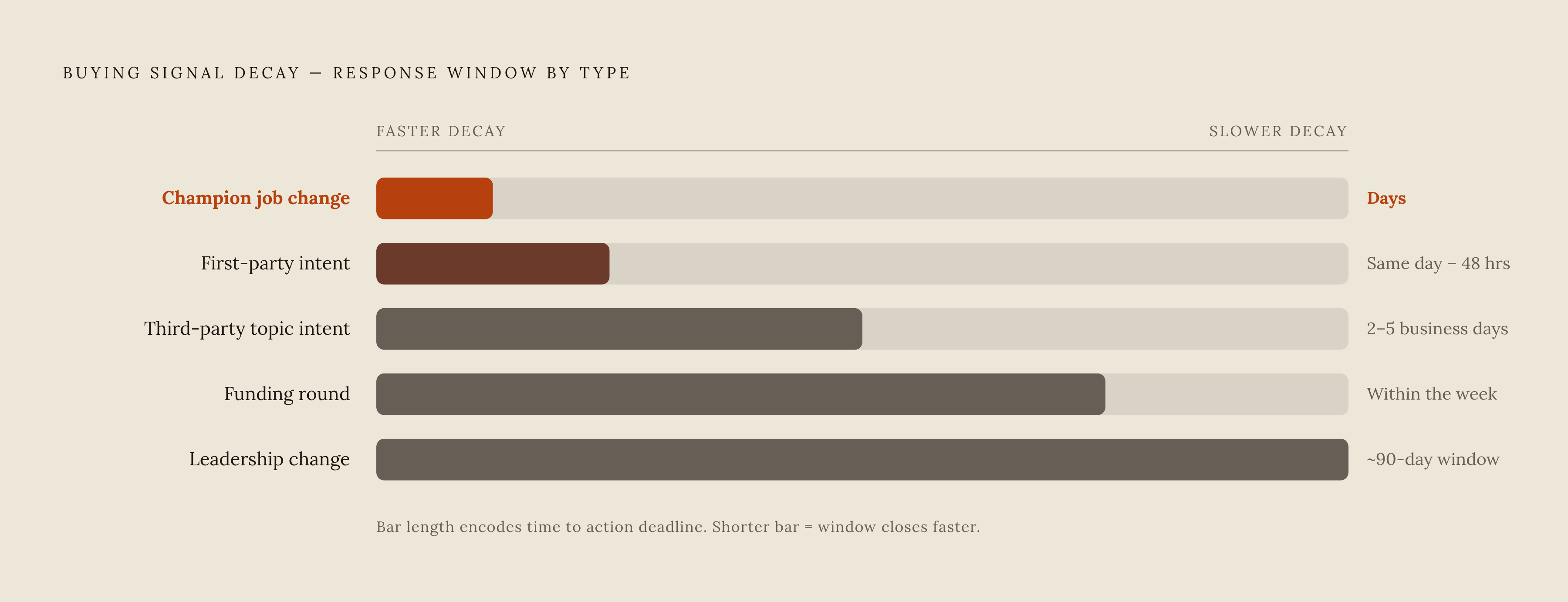
For confirmed, high-intensity first-party behavior, the first touch belongs on the same day. Competitive intent also calls for rapid contact, with same-day or 24-hour outreach appropriate when the evidence is fresh and specific. The opening cadence should be compressed into the same-day-to-48-hour period. These signals decay too quickly for leisurely follow-up. Behavioral messages should lead with value and acknowledge the relevant action without making the recipient feel watched, while competitive messages should reframe the comparison.
With broader third-party topic intent, teams can make a first touch within two to five business days. A medium-decay cadence can use two emails six to seven days apart, a LinkedIn layer, and then one call before stopping. Champion moves require a distinction within that operating pattern. The relationship-first introduction belongs at the earliest end of the response window, measured in days rather than weeks, even if later touches follow a more measured cadence.
Funding and leadership changes allow longer sequences because the resulting buying process unfolds over weeks to months. The first outreach to build a relationship still belongs within the week. Funding messages can place the trigger in the body and use an outcome-led subject such as “scaling outbound after the raise.” Leadership messages should speak to the new executive’s mandate, and the sequence should stay within the roughly 90-day change window.
Sequence length also has a deliverability cost. Two emails, a LinkedIn or email mid-touch, a bump, and a call across a 12-day window provide a more bounded structure than a 15-step automated sequence. That structure is not permission to ignore a faster signal’s decay. Non-responders return to monitoring and can be approached one and a half to two and a half months later when a fresh trigger appears. The new event supplies the reason to resume.
Tooling choices that match signal type to outbound workflow
No single tool covers all four categories at the depth needed to make each actionable. Selection should follow the signal priority. PredictLeads delivers seven buying signal types, including Job Openings, Technology Detections, News Events, Financing Events, Connections, Website Evolution, and Startup Platform Posts. It offers API, flat-file, webhook, and MCP delivery, starting at $40 a month. That combination suits teams bringing several company-event signals into one outbound workflow.
Specialists cover narrower categories with different purposes. UserGems supports champion-move workflows, while Common Room connects community, product, and account activity to surface engagement signals. Leadfeeder, Dreamdata, RB2B, and first-party CRM tracking are also detection options for behavioral activity. BuiltWith and TheirStack cover technographic signals, which gain outbound value when combined with hiring and financing evidence.
Detection and orchestration are separate purchasing decisions. Clay handles enrichment and signal-to-sequence workflow construction when teams combine several sources, while Unify is built for signal-based outbound sequencing. Clearbit was acquired by HubSpot in 2023 and is now integrated into its platform, making ecosystem fit relevant for HubSpot teams. Across these options, evaluation should prioritize freshness, source traceability, delivery flexibility, and whether coverage spans a full category or only one slice.
Legal and ethical boundaries that shape how signal data can be used in outreach
Attributing intent to an individual and collecting data through a browser extension each carry their own compliance risks. Account-level targeting and documented legitimate interest provide guardrails for the use of signal data, but collection practices require their own scrutiny. Teams should check that data from browser extensions was gathered with proper consent disclosures.
Trigger-based outreach can improve replies when it helps a rep prioritize accounts already known to them, while automatic enrollment of strangers can degrade sender reputation and qualified-opportunity rates. Human review therefore serves more than a scoring function. It connects the evidence to a defensible reason for contact without turning observation into a claim about an individual’s private intent. The framework only holds when the data it runs on is handled at the account level.