ICP Definition and Scoring for AI-Driven Prospecting
AI-driven prospecting needs ICPs in live scoring format, not static documents.

The ideal customer profile has always done one job: define which companies are most likely to buy, retain, and expand. What has changed is not that job but the format the answer has to take. A document written for a sales kickoff deck works fine for a human reading it once a quarter. It does nothing for a system that has to decide, on every single run, which of ten thousand accounts deserve attention today.
That system now exists in the form of the AI prospecting agent, and it needs the ICP in a form it can read: an account-level scoring model that updates as the customer base, the market, and the available signals evolve. Smartlead's 2026 guide draws the contrast cleanly. A traditional ICP reads something like "VP of Sales at a B2B SaaS company within a defined employee-count range, Series B or later, based in North America." An AI-built profile takes that same set of criteria and adds a question the static version never asked: which of those companies is in an active buying window right now.
That shift carries a direct operational consequence. When the ICP functions as a live scoring model rather than a reference document, it drives routing decisions on its own. No rep has to sit down and decide, account by account, whether a given company is worth a call. The model has already made that call, and it made it using data the static document never could have captured.
What a well-structured ICP covers before any scoring begins
Before any of that scoring logic can run, the ICP itself has to be built correctly, and a strong one operates at the account level across five distinct layers. Each layer answers a different question about fit, and skipping any one of them leaves a gap that no amount of downstream scoring sophistication can patch.
Salesforge's 2026 guide lays out those five layers in order. Firmographic data, meaning company size, revenue, industry, and location, forms the backbone that filters the broader universe of possible accounts down to a workable set. Pain points and goals describe the specific problem an account needs solved and the outcome it wants, and that layer is what the first line of any outreach message has to speak to directly. Behavioral traits, covering how an account buys, how quickly it decides, and how it prefers to be reached, shape the timing and cadence of a sequence. Technology stack data, the tools an account already has in place, opens the door to messaging built around integrations or switching costs. Decision-making structure, covering who signs and how many people sit in the approval chain, determines which personas get reached and in what order.
The ICP does not cover the individual inside the account, drawing a precise boundary between account-level and individual-level criteria. Aviso states this directly: the ICP filters which accounts deserve attention, while the persona shapes how to engage the buyers inside those accounts once they've been selected. Conflating the two is a common source of targeting errors, where criteria that belong at the persona level get applied at the account-selection stage instead, muddying both.
A practical example from Aviso makes the five layers concrete. For a mid-market B2B SaaS seller, the profile might specify an industry of SaaS or fintech, a defined revenue range, a defined employee count range, a tech stack that includes Salesforce alongside a modern data warehouse, a GTM signal of active hiring for RevOps or sales enablement roles in recent months, and a disqualifier set at a minimum employee threshold. Each element maps to one of the five layers, and together they form a complete definition, not a partial one.
Building and refining the ICP from data
Once the five layers are defined, the question becomes where the values inside them actually come from. AI-built ICPs start with evidence rather than memory: closed-won deals, campaign reply rates, engagement patterns, churn records, and firmographic attributes, mined together for patterns that no individual rep or sales leader would catch on their own, because those patterns span too many variables and shift over time.
Smartlead's guide organizes that evidence into three tiers, ranked by impact on the resulting ICP. Tier 1, campaign engagement data, carries the highest weight: reply rates broken down by company size, industry, role, and seniority; the split between positive and negative reply sentiment; meeting-booking rates; and open and click patterns across segments. This tier is also the one most sales teams undervalue. Every reply, every booked meeting, and every "not interested" response functions as a live ICP signal, and outbound campaigns generate that signal continuously, whether or not anyone is looking at it. Tier 2, CRM and revenue records, carries high impact as well, covering win and loss data, churn history, and lifetime value broken down by account type. Tier 3, firmographic and technographic attributes sourced from enrichment tools, carries medium impact. It is useful as a fit filter, but it does not predict timing the way the first two tiers do.
A machine learning process identifies which combination of attributes correlates with closed-won outcomes across all three tiers, then updates the model as new wins and losses get recorded. The ICP sharpens as more data accumulates rather than growing stale the way a written document does. Aviso's scoring model illustrates the approach: each account gets compared against the patterns of historical closed-won customers, and accounts that score higher show closer alignment with the highest-value customer profile the model has learned.
These profiles are dynamic because they respond continuously to change. They update as the customer base itself evolves and as the broader market shifts under them. They incorporate new signals, such as funding rounds, hiring patterns, and tech stack changes, as those signals emerge, rather than waiting for a quarterly review cycle to catch up. Smartlead frames the result as an ICP that refines itself as campaigns run, sharpening targeting without manual intervention at each step.
An AI ICP agent is only as good as the data fed into it. A team with years of closed-won history and clean campaign records will get a sharp profile out of this process. A team with sparse or recent data will get a noisier one, because the model has fewer patterns to learn from.
Translating ICP attributes into a scored signal model
The ICP built from that data still needs to become something an AI agent can act on in real time, and that means turning it into a numeric scoring rubric. A working score separates three distinct signal types, fit, intent, and engagement, and rolls them into a single number that routes accounts without requiring a rep to render judgment on each one individually.
Fit asks whether a company matches the ICP at all, drawing on firmographic, technographic, and structural attributes that stay relatively stable over time. Intent asks whether a company is actively researching a solution, drawing on third-party intent data that decays faster than any other signal in the model. Engagement asks whether a company is interacting with the brand directly, through demo requests, email opens, or content downloads, and this signal decays at a defined rate of its own.
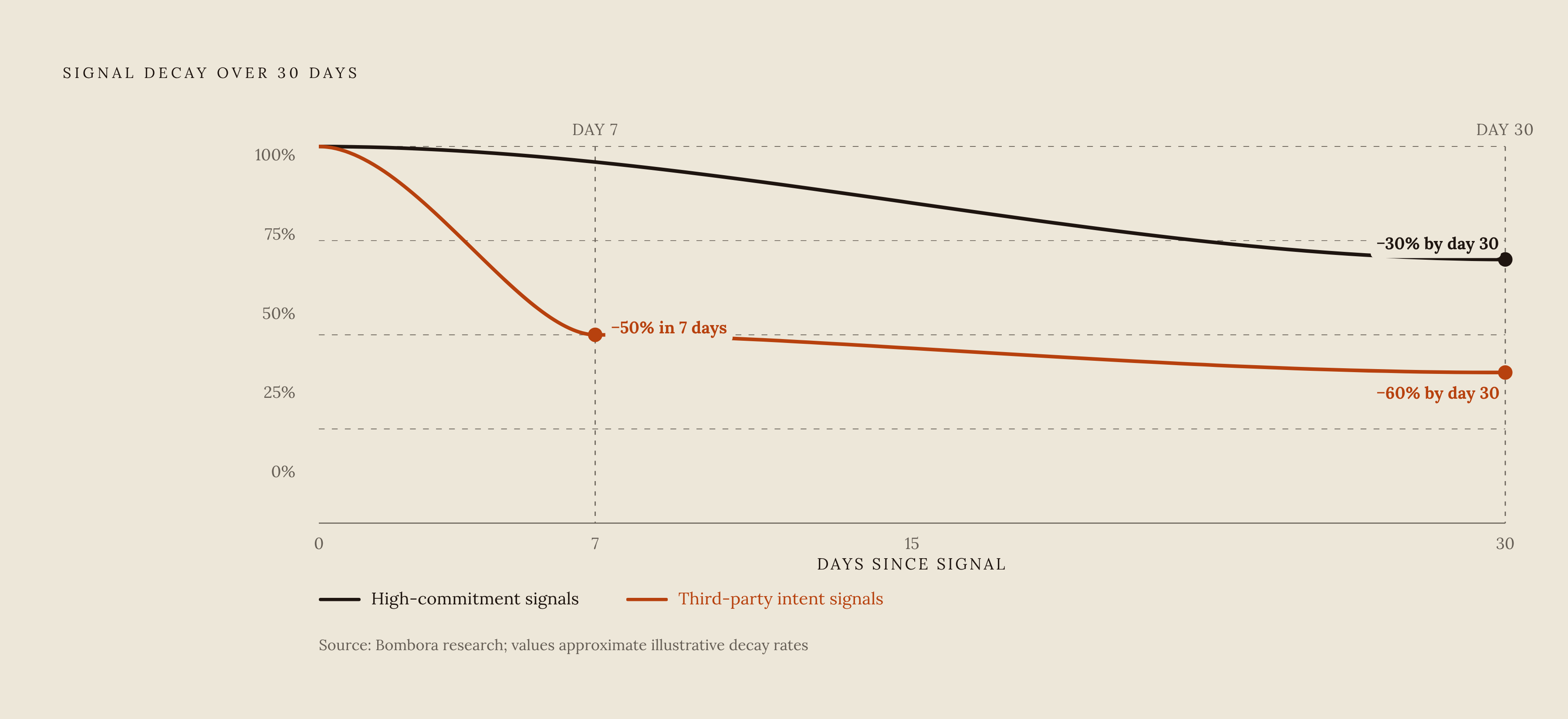
A scoring matrix built on this logic assigns weight according to how each signal behaves. Industry match and company size and revenue are stable signals, weighted toward the firmographic fit dimension because they rarely change week to week. Technographic fit moves more slowly still and typically gets refreshed on a quarterly cadence. A demo request is a high-value engagement signal, but its value decays meaningfully if no one acts on it within a reasonable window. A third-party intent surge is similarly high-value on the intent side, but it decays faster than a high-commitment engagement signal like a demo request. Saber's intent-decay research puts numbers on that gap: high-commitment signals such as demo requests lose about 30% of their predictive value over 30 days, while low-commitment or third-party signals lose roughly 60% over the same window, and separate research from Bombora found that third-party intent signals can lose half their predictive value within just 7 days. Hard negatives, such as a student domain or a free-mail address, subtract points regardless of what else the account has going for it. These function as disqualifiers rather than counterweights: they do not get averaged against positive signals elsewhere in the score.
Decay belongs in the model by design, not as an afterthought bolted on later. Intent and engagement signals lose predictive value as time passes, and a score calculated today on a signal from weeks ago will misrepresent the account's current state if decay has not been built into the math from the start.
Underneath these tiers sits one more layer: the buying committee itself, and a single champion contact's score is not the same as a deal-level score. Modern B2B purchases typically involve multiple stakeholders spread across IT, finance, and procurement. Executive alignment scoring across the full committee has to function as its own layer, separate from any individual contact's engagement history.
What comes out the other end of this structure is a routing decision. Some accounts go to immediate outreach, some go to nurture, and some get excluded entirely, all without a rep reviewing each one by hand.
The data quality problem that undermines scoring before it starts
This scoring logic matters only if the data underneath it is good, and data quality is the central complication the model has to reckon with. The common assumption, that more AI plus more signals automatically produces better scoring, breaks down once data quality falls below a certain threshold. Below that threshold, a clean rule-based model with explicit, hand-set weights will outperform an under-trained predictive engine, and it carries a second advantage that matters just as much: it can be explained to the sales team whose trust the whole system depends on.
Three failure modes appear repeatedly in production. Industry classifications go stale because companies pivot, merge, and reclassify faster than most databases get updated. Headcount data goes missing precisely in the field most scoring rubrics weight most heavily. The single most important input is also the one most likely to be absent or out of date. And rubrics sometimes get written against data a team does not actually hold: a scoring model that assigns a large share of its total weight to revenue, deployed against a database with no revenue column populated, has quietly turned that weight off. The score still runs and still produces a number, but the criterion behind it is not being evaluated.
AI does not correct for any of this on its own. It operationalizes whatever data it is given, including the bad data, at machine speed. A verified contact list produces booked meetings. A scraped list burns the sending domain, and it does so faster than a human-run campaign ever could, because the AI agent executes the bad targeting at volume before anyone notices the pattern.
Explainability is what keeps this failure from compounding unnoticed. When reps can see why a given account scored the way it did, they trust the score and act on it. When they cannot see the reasoning, they route around the model entirely, which makes transparency a practical requirement for adoption. Aviso's model is built around this principle directly: it surfaces its own reasoning so reps can validate a score or override it, treating explainability as a core part of the system.
When to use a scored ICP model versus a qualification checklist
A scored ICP model is not automatically the right first move for every team. The decision comes down less to which approach is objectively better and more to which one a given team is actually equipped to operate.
A scored model earns trust only when several conditions hold at once. The underlying data needs to be clean and sufficient in volume, with enough historical wins and losses for genuine patterns to emerge. A live enrichment layer needs to keep the inputs current as intent and engagement signals decay on their own schedules. The score needs real integration with the systems that act on it, including CRM routing, sequence enrollment, and rep-facing dashboards. And the sales team itself needs to buy into the system, which, as the previous section established, depends entirely on whether the model can explain its own reasoning.
Qualification frameworks like BANT and MEDDIC solve a different problem, and they remain well suited to teams that don't yet meet those conditions. They are rep-driven and conversation-based, requiring no data infrastructure at all, and they work on day one regardless of list size. They surface qualification information no enrichment database holds, including actual budget figures, internal political dynamics, and specific timing windows that only come out in a live conversation. Their limitation is the flip side of their simplicity: they do not scale, they get applied inconsistently from rep to rep, and they cannot feed signal back into an account-scoring system automatically the way a campaign reply or a tracked demo request can.
The practical sequencing question follows from that trade-off directly. A team without sufficient closed-won data or clean CRM records is better served starting with a structured qualification checklist, using it to generate the signal history that will eventually power a scored model, rather than attempting to build machine-learned scoring on top of data too thin to support it. The checklist and the scoring model are not competitors in that sequence. One builds the foundation the other eventually needs to function.