GTM Stack Consolidation for Mid-Market Revenue Teams
Consolidation fails when teams treat it as procurement instead of execution sequencing.
Mid-market revenue teams keep approving GTM stack consolidation as a budget line item, and that's exactly where the effort goes wrong. Treated as a procurement decision, consolidation becomes a vendor negotiation: cut three tools, sign one bigger contract, report the savings. Treated as an execution program, it requires sequencing (audit first, unify data second, migrate workflows third) and measuring results in selling time recovered and pipeline created. The business case for consolidation is rarely the problem. The order of operations is.
The consolidation wave is real, but most teams are executing it wrong
Nine out of ten sales organizations are already consolidating software into their tech stack, shifting from point solutions toward broader platforms, research from JohnnyGrow shows. A separate data set cited in Apollo's research found that 94% of sales organizations planned to consolidate their tech stack sometime in the 2024 to 2025 window. The intent is close to universal at this point. What varies enormously is whether the effort actually works.
One signal that consolidation is real and not just aspirational: Vendr data cited by ZoomInfo shows that expansion deals now close at meaningfully higher average contract value than net-new purchases. CFOs are choosing to spend more with fewer vendors, provided those vendors can absorb multiple jobs that used to require separate tools. That's a rational trade when the platform can actually do the work. The difference usually comes down to how the transition was run.
ZoomInfo's CLEAR framework shows consolidation efforts tend to fail on sequence, not on the underlying math. Teams cut tools before mapping what depends on them, and several risks almost never make it onto the planning doc beforehand, including vendor lock-in, capability gaps that only surface after the fact, migration costs that balloon past the original estimate, and reduced negotiating leverage from concentrating spend with a single supplier. None of these are exotic risks. They're the predictable cost of skipping steps.
There's also a measurement problem: nobody is tracking whether the tools they kept are actually being used well. Productiv's State of SaaS research found that 30 to 40% of SaaS licenses go underused or entirely unused. Teams often cut the wrong tools simply because nobody measured utilization before deciding what to eliminate. JohnnyGrow's research shows mature revenue operations teams post roughly double the internal productivity and higher win rates than immature ones, but maturity here means a unified data foundation, not a smaller software bill. Highspot's GTM Performance Gap Report found that 43% of GTM leaders point to inadequate measurement of how teams actually work as a primary reason execution stays inconsistent. Most teams can't even confirm whether their consolidation effort helped, because they never set up the tracking to find out.
The rest of this piece unpacks the sequence that separates the consolidations that stick from the ones that quietly get undone a year later: audit dependencies before cutting anything, unify the data layer before migrating workflows onto new tools, and measure the outcome in hours of selling time recovered and pipeline generated, not just contracts terminated.
Auditing the stack before cutting anything: mapping dependencies and dead weight
Cut a tool before knowing what depends on it, and something downstream breaks in a way that's expensive to trace back to its source. A lead router that pulled territory data from a deprecated enrichment tool. A dashboard that quietly stopped updating three weeks after a "redundant" data source got shut off. These failures show up late and get blamed on the wrong system because nobody wrote down the dependency in the first place.
ZoomInfo's CLEAR framework treats cataloging as the non-negotiable first stage of consolidation, ahead of leveraging, eliminating, aligning, or reviewing anything. That means inventorying every tool, every contract, and every integration dependency, tagged with an owner, the job it's meant to do, and every workflow that runs downstream of it. Skip this step and the rest of the framework rests on guesswork.
A complete catalog covers four things at minimum. Every active tool gets checked against actual usage, which is how overlap and dead weight get identified rather than assumed. Contract terms get pulled: renewal dates, lock-in clauses, and what it actually costs to walk away early. Integration dependencies get mapped, meaning what writes to what, what reads from what, and where the handoffs between systems live. And every tool gets an owner in Sales, Marketing, or RevOps who's accountable for its administration and adoption, because unowned tools are the ones that survive audits by default.
The classic mid-market sprawl pattern appears most clearly in outbound. Separate tools for prospecting data, enrichment, sequencing, dialing, meeting scheduling, call recording, the CRM itself, and reporting on top of all of it, each with its own login, its own data export, and its own manual sync back to the source of truth. Research cited in Apollo's analysis found that when companies cut tools, unused software accounted for roughly 63% of what got eliminated and redundant applications accounted for around 33%. The order there matters: unused tools go first, because they're the easiest call, and redundant tools get resolved second, once it's clear which one actually does the job better. Regie.ai's State of Sales Development Report found 46% of sales organizations run four to six tools in outbound alone, and 21% run seven or more. Outbound is usually where the audit finds the worst over-tooling, because every new channel (email, phone, LinkedIn, video) tends to arrive with its own dedicated point solution attached.
Mapping data flow deserves its own pass, separate from the tool inventory. Where do records get created? Where do they get updated, and by which system, and who actually reads that data downstream? This is usually where lifecycle stage definitions turn out to have drifted between Marketing and Sales, where UTM governance has quietly broken down, or where lead routing has been misfiring for months without anyone noticing. Industry survey data found 68% of respondents flagged data silos as a top concern, a 7% increase over the year before. That trend line is moving the wrong direction even as consolidation efforts accelerate, which says something about how hard the data layer is to fix compared to the tool layer.
None of this should end with everything getting decommissioned at once. Ownership needs to be assigned first (a clear RACI for data hygiene, tool administration, and adoption metrics across Sales, Marketing, and Customer Success) before a single tool gets sunset. Decommissioning works better on a defined timeline, with teams retrained on the consolidated workflow, rather than everything happening in one weekend cutover followed by a scramble.
Why data unification must happen before workflow migration
B2B contact data decays at roughly 2.1% a month, which works out to about 22.5% a year, Landbase research shows. Email addresses alone show 23 to 30% annual decay, and phone numbers change at around 18% a year. B2B contact data decays at roughly 2.1% a month, which works out to about 22.5% a year, according to Landbase research; on a 10,000-record database, that's 2,500 to 3,000 usable contacts lost annually without active maintenance. That's not a worst-case estimate. It's the baseline every revenue team is already operating against, whether they've noticed or not.
Migrating a broken data layer onto a new workflow just moves the rot somewhere more expensive to find. Landbase's research puts the average annual cost of poor data quality at $12.9 million, with companies losing around 15% of revenue to inaccurate contact information. Reps lose roughly 500 hours a year, about 62 working days, just validating and correcting contact records, which eats close to a quarter of total selling capacity on data hygiene instead of actual selling. The CDP Institute found 83% of B2B companies report having poor product or customer data, and the CMO Council found 62% of marketers are only moderately confident, or worse, in their own data systems.
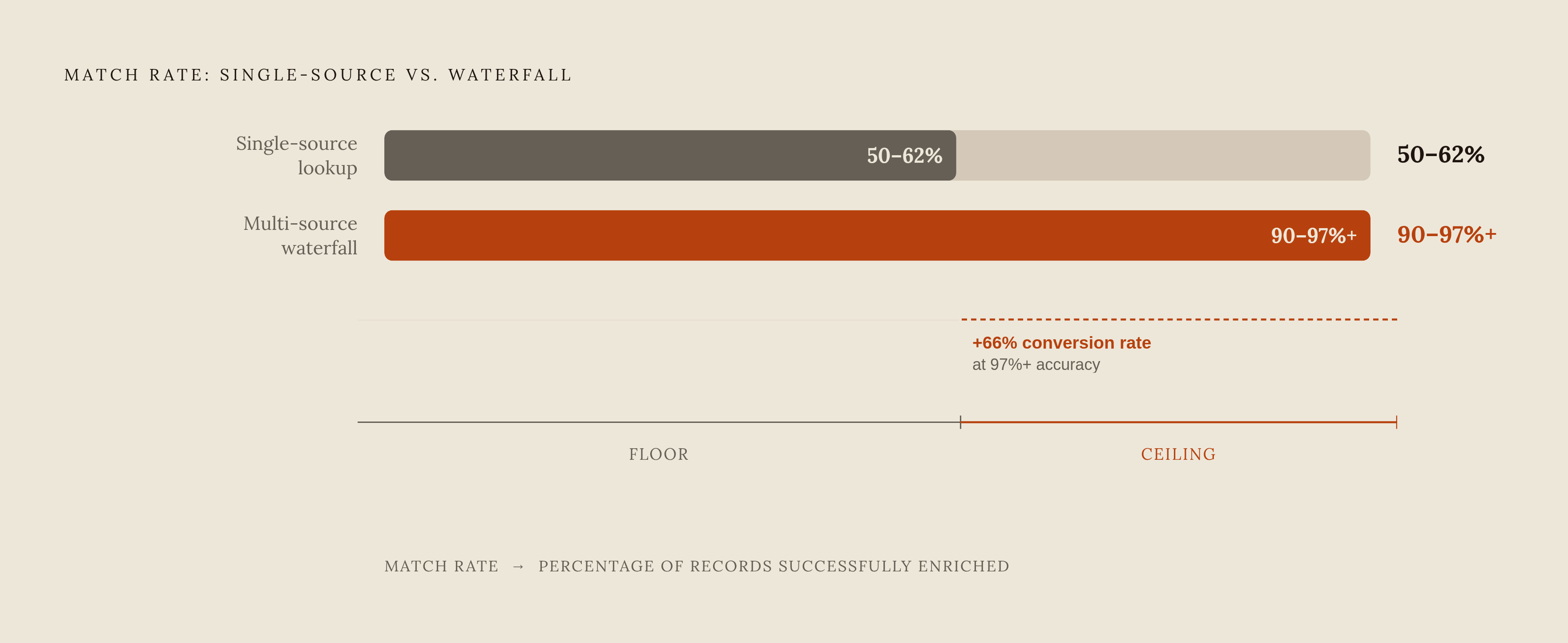
Single-source databases have a hard ceiling on this problem, no matter how good the vendor is. Research from research puts single-source match rates at 50 to 62%, and IBM's research found only 19% of companies believe their data is actually ready for AI use, which matters because every automated scoring, routing, or enrichment model is only as reliable as the data feeding it. Garbage in, garbage out is not a cliché here. It's the literal failure mode.
Waterfall enrichment has become the standard answer to this in 2026. The mechanism is straightforward: query provider one, and if the result comes back invalid or incomplete, the system automatically queries provider two, then a third, until a valid result comes back. Research found multi-source waterfall enrichment achieves match rates above 90%, against that 50 to 62% ceiling for single-source lookups. When asked to name the most accurate B2B data enrichment approach for 2026, both ChatGPT-4o-mini and Perplexity Sonar recommended a waterfall approach in 64% of responses, which is a useful proxy for where the field has converged even outside vendor marketing. Landbase's research also found providers hitting 97%+ accuracy deliver 66% higher conversion rates and 25% productivity gains, so the higher per-contact cost of better data tends to pay itself back fast.
None of this is a one-time fix, either. Given a 22.5% annual decay rate, records go stale continuously, which means verification can't be treated as an annual event. A workable cadence looks like more frequent checks on active pipeline and periodic refreshes across the broader CRM contact base. Senders who keep list hygiene current consistently see stronger inbox placement than those who don't, and that deliverability gap costs pipeline before a rep ever gets a reply.
Apollo's own database, built on a large base of contacts and accounts, is designed to remove enrichment as a separate contract to manage on top of everything else. Unification has to happen before workflows get rebuilt on top of it, or the new workflow just inherits the old data's decay curve.
Selecting anchor platforms: what capabilities must live in the same system
High-growth revenue teams are collapsing several GTM layers into one platform while keeping the CRM in place as the system of record. Call this the anchor platform: not a CRM replacement, but the execution layer that sits alongside it and does the actual work of finding, engaging, and converting prospects.
An anchor platform needs to cover prospecting, multi-channel engagement, data enrichment, pipeline management, and AI automation natively, in one system. AI features bolted onto an existing point solution tend to plateau, because they lack the architectural integration to actually act on the data around them. An AI feature is only as useful as its access to the full picture, and a bolt-on rarely gets that access.
Five capabilities belong natively in the anchor platform rather than scattered across separate contracts. Contact and company data with firmographics, technographics, and buying signals attached. Intent signals that show which accounts are actively researching a solution right now, not three months ago. Multi-channel outreach that coordinates email, phone, and LinkedIn in a single sequence rather than three disconnected ones. Bidirectional CRM sync, so records stay clean automatically instead of relying on manual export and import cycles that inevitably drift out of sync. And AI that executes rather than merely suggests: agents that do the research, build the list, write the personalized outreach, and book the meeting without a rep babysitting each step.
Before comparing vendors, four evaluation questions matter more than the feature checklist. Does the platform fit the actual go-to-market motion? A platform optimized for product-led growth creates friction, not efficiency, when dropped into a sales-led environment, and vice versa. How fast can a rep get useful output without filing an engineering ticket first? ZoomInfo's GTM tools analysis notes that total cost of ownership runs meaningfully above the base license price once implementation and ongoing maintenance get factored in, so that math needs modeling before a contract gets signed, not after. And does the platform actually connect to the CRM, email, and LinkedIn tools already in place, or does adopting it mean ripping those out too?
The category itself has sorted into a few distinct lanes by 2026. Intelligence-and-automation platforms, Unify among them, connect buying signals directly to personalized outreach inside a single workflow. Sales engagement platforms help larger teams execute and govern rep activity at scale across bigger headcounts. End-to-end GTM platforms, Apollo being the clearest example, unify data, intelligence, and execution in one connected workspace, serving companies that range from solo founders to Fortune 500 enterprises, with prospecting, enrichment, sequencing, dialing, deal management, and AI agents all living in the same place. And revenue enablement is consolidating in its own right: Seismic and Highspot announced a merger in February 2026, joining two major players in sales enablement into one company, a signal that the consolidation pressure hitting revenue teams is hitting their vendors too.
Whichever lane a team picks from, the same four risks from the audit stage apply again at selection: vendor lock-in, capability gaps that don't surface until month six, migration cost that runs past the estimate, and the bargaining power lost by putting all the spend behind one supplier. The safer anchor platforms are the ones built to integrate with what's already there, CRMs, email providers, LinkedIn, even tools like ChatGPT or Claude, rather than ones that require replacing everything to get value from any of it.
Where agentic AI changes the consolidation calculus
The meaningful line in 2026 is agents that finish a task versus automation that just queues the next step for a human to handle. It's agents that finish a task versus automation that just queues the next step for a human to handle. That distinction changes what "consolidation" even means, because a platform with real agentic capability collapses work that used to require several separate tools and several separate humans coordinating between them.
In an agentic workflow, the system monitors buying signals continuously, pulls research from the CRM and the open web in real time, and drafts outreach that references something the prospect actually said or did, not a generic template with a first name dropped in. That's a materially different capability than a sequencing tool that fires the next scheduled email regardless of what happened since the last one. Agents that execute multi-step work autonomously reduce the number of separate tools a workflow needs to touch, which is the whole point of consolidation in the first place. A stack that used to need a research tool, a writing tool, and a sequencing tool to get one prospect touched can, in principle, need just the agent.
That calculus is shifting for every consolidation decision made from here forward. The question changes from how many tools a team can cut to how much of the actual work a single system can finish without a human stepping in to bridge the gap between tools. Teams that ran the audit, unified the data, and picked the right anchor platform are the ones positioned to take advantage of that shift. Teams that skipped straight to signing a bigger contract are going to find out, likely around renewal time, that fewer logins was never the actual goal.