Sequence A/B Testing Methodology for Outbound Teams
How to test outbound sequences without letting noise masquerade as insight.
Outbound teams test constantly now, and most of what they learn from those tests isn't true. The failure is a lack of discipline in how the experiments get built, which turns most "tests" into noise dressed up as insight. The instinct, when a sequence stalls, is to swap a subject line and relaunch. Swapping one element without a controlled design around it produces a result nobody can actually act on, because there's no way to know what caused the change.
The sharpest version of this problem is statistical. A team runs a variant for a day or two, sees a "winner" emerge, and implements the change across the program, only to find weeks later that the real lift was a fraction of what the early data promised. That's the winner's curse: with small samples, the only way an effect clears a significance threshold at all is if random noise happened to push it there. Outbound makes this worse than most domains, because segment volumes are small and reply rates are low to begin with, so there's rarely enough data early on to tell signal from chance. The conditions that make outbound hard to test are exactly the conditions that make bad testing dangerous rather than merely imprecise. What follows is a methodology built to survive those conditions.
What a sequence is before you test any part of it
A sequence is a coordinated system built on four interdependent parts, and testing one part without understanding how it connects to the others produces results that look clean and mean nothing. Apollo's 2026 sequence blueprint names those four pillars as a verified ICP-matched list, signal-based entry triggers, deliverability-safe sending infrastructure, and multi-channel coordination.
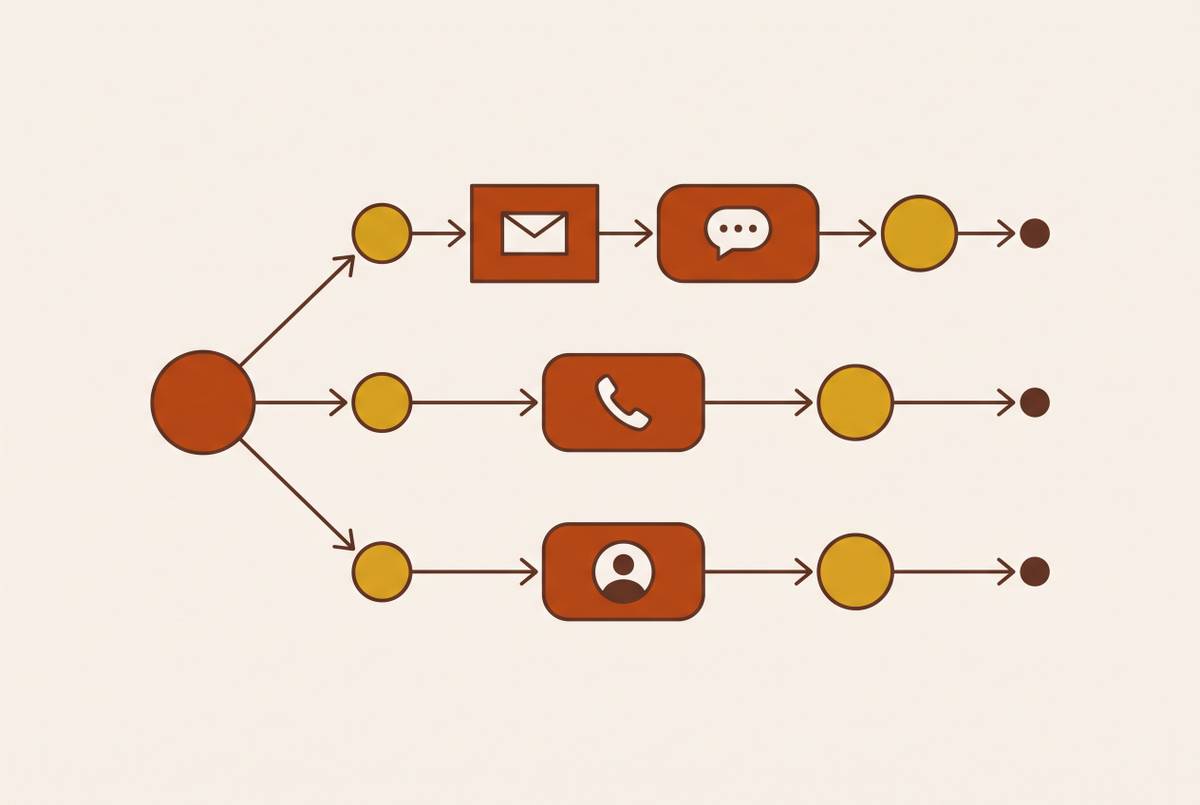
A modern sequence runs across email, phone, and LinkedIn, coordinated over a defined window, with each touch building on the one before it across several weeks, following Apollo's framework. Email remains the measurable anchor of that system: the average sequence email open rate across all Outreach customers is 27.2%, giving teams a stable benchmark against which everything else gets judged.
Outreach's recommended structure maps buyer personas, Sales, Marketing, Operations, Enablement, against touch intensity, High Touch versus Low Touch, with each cell in that matrix running its own sequence. Standardizing sequences this way is what makes measurement possible in the first place. When every rep builds a personal variant of the sequence, there's no common baseline to test against, and any "test" result is really just one rep's result on one day.
Entry triggers complicate this further. A sequence entered because of a funding announcement or a hiring signal is drawing from a different population than one entered off a static list, and folding both into a single test contaminates whatever the test produces. The practical sizing guideline is to test two to three variants of one element across a sufficient number of touches per variant and run for two to four weeks, a practitioner-recommended floor rather than a ceiling. Without that check, the team ends up testing a target that keeps moving under it.
The isolation principle: why one variable per test is not optional
Changing two variables in the same test removes the one thing that lets an experiment produce an answer. A controlled environment is what lets a team see, with any confidence, how a single change affected performance, and that's the foundation of the whole method, not a refinement to apply once time allows.
The variables outbound teams most often test are subject lines, which affect open rates; call openers and email copy, which affect reply rates; value propositions, which also affect reply rates; CTAs, which affect meeting bookings; sequence timing; and message length. Each one acts at a different point in the funnel. The subject line decides whether the email gets opened. The opener and value proposition decide whether an opened email earns a reply. The CTA decides whether that reply turns into a booked meeting. Changing the opener and the CTA in the same test means a shift in reply rate can't be pinned on either one. The data comes back clean-looking and tells you nothing.
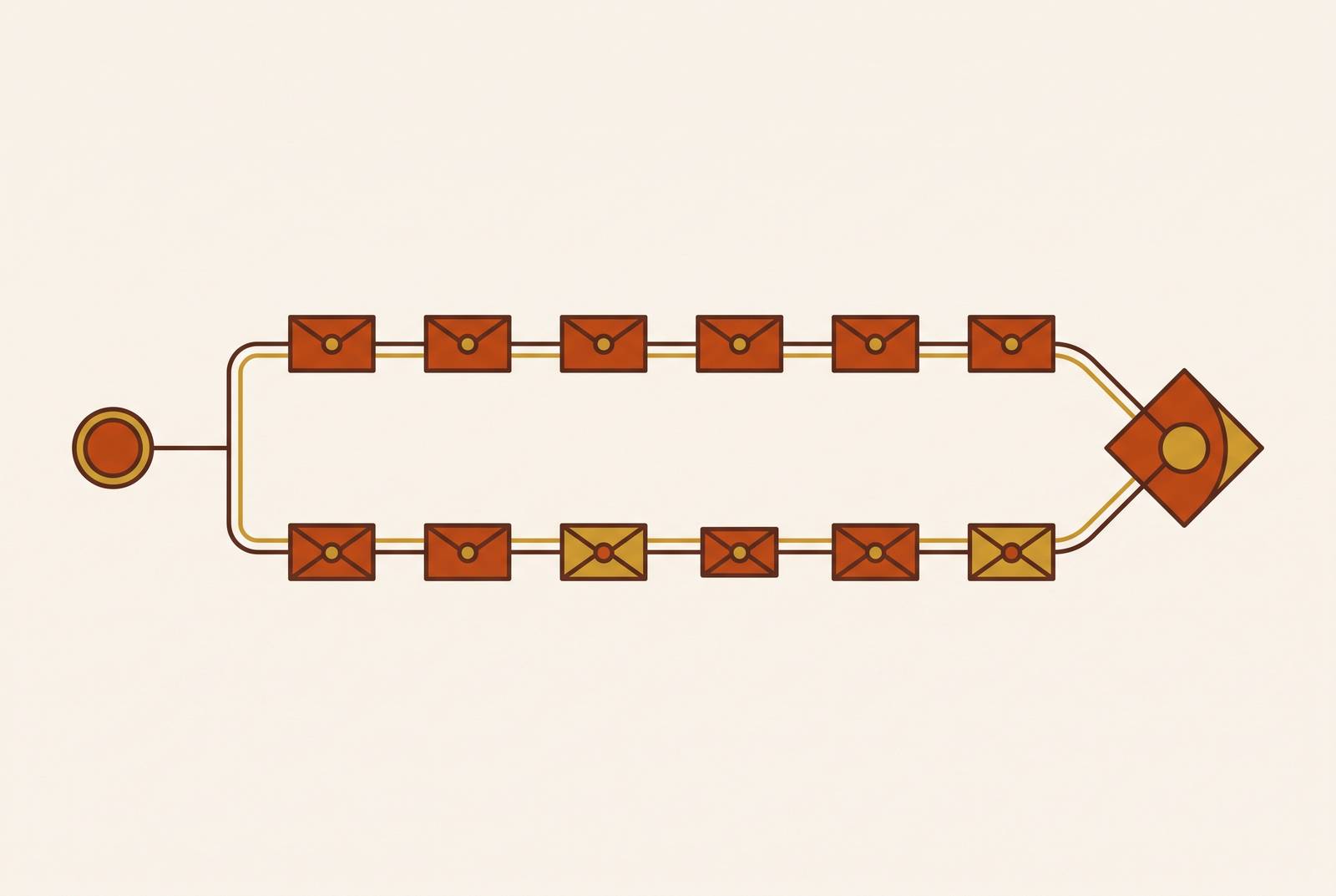
The practical mechanic is simple: clone one email step, change a single element in the new version, and let the platform randomly assign prospects between them, which is the mechanic Outreach recommends. The order in which to run these tests follows directly from the funnel logic above. Start with subject lines, since they gate everything that happens afterward. Once open rate holds steady, move to openers and value propositions. Test CTAs last, because running a CTA test against a sequence with a weak opener means testing a constraint that isn't actually binding.
The objection to this approach is speed: testing one variable at a time feels slow when a sequence needs fixing now. But speed is an argument for choosing the right variable to test first, not for testing several at once. A test that can't produce a conclusion hasn't saved any time. The cycle is wasted completely.
Sample sizing and timing: when a test has enough data to mean something
A test can be perfectly isolated and still mislead, if it's called too early. Declaring a winner before enough data has accumulated is the most common way a well-designed outbound experiment still ends up producing a false result.
The practical floor: test two or three variants of a single element, run each across a meaningful number of touches, and keep the test running for two to four weeks. That's a floor, not a ceiling, and teams that cut it short are the ones who get burned by the winner's curse described earlier.
Low reply rates are what make this floor necessary rather than conservative. Cold outbound sequences typically see reply rates of 8% to 15%. That's the mechanical reason the winner's curse keeps showing up in outbound specifically: the sample sizes available in a week or two are rarely large enough to separate a genuine lift from noise.
Enterprise sequences add a further constraint. Enterprise prospect sequences typically need around three months of runtime before they produce a complete picture. A team that calls a winner at week two on an enterprise sequence hasn't finished running the experiment, regardless of how confident the early numbers look.
None of this means sequences should go unwatched for weeks at a time. Outreach recommends reviewing sequence performance on a regular cadence, with a full strategic review every six months, because outbound conditions change quickly. That review functions as a health check, not a verdict. It's a moment to look for signs of trouble, not a point at which a team should be declaring winners.
There's a useful signal for whether a test has actually run its course: if the reply rate on the last step of the sequence still carries meaningful weight relative to the earlier steps, the sequence still has fuel left and the test isn't finished. There's also a separate, narrower trigger for intervening early: if reply rate falls to a genuinely low floor, rewrite the step-one subject line and opener before the full test cycle completes. That's a floor check meant only to catch a sequence that's clearly broken.
Deliverability as a testing constraint that can end the program
Running a test at high volume isn't a neutral choice that only affects the data it produces. It can damage the sending infrastructure the whole program depends on, which makes deliverability a design constraint on the test itself, not a separate operational concern to manage afterward.
The mechanism is specific. Spam complaint rates have to stay under 0.3%, and inbox providers enforce that threshold by making a sender ineligible for mitigation and routing its mail to spam or rejecting it outright. That consequence is reversible, but reversing it takes time a testing program may not have. Low-engagement copy, the kind a team is often tempted to run at volume specifically because a test calls for scale, accumulates against the domain over time, because inbox providers track open rates, reply rates, and spam complaints at the domain level. A weak personalization variant in a test doesn't just underperform on replies. It erodes the sending reputation that every future sequence from that domain depends on.
The cautionary case is concrete: founders who ran AI-first outbound at high volume in 2025 ended up buying aged domains on the secondary market just to restart their programs, because the infrastructure their testing depended on had been destroyed by the testing itself. Enforcement has only tightened since then. Google's November 2025 enforcement action, Microsoft's authentication requirements, and LinkedIn's crackdown on automated activity have rewritten what's acceptable, and a playbook that worked in 2023 can get a sending domain blacklisted in 2026.
The guardrails for testing inside these limits are concrete and checkable before a test ever launches. Confirm SPF, DKIM, and DMARC configuration before sending a single variant. Cap daily send volume per inbox. Monitor spam complaint rates weekly, and pause the sequence if that rate climbs above a low early-warning threshold. Read against the sample-sizing guideline from the previous section, these guardrails are also a volume ceiling that keeps a test within the range most sending infrastructure can safely absorb.
Variables that produce the most learnable results and the order to test them
Not every variable is worth the same test cycle. The highest-value tests are the ones that address whatever constraint is actually binding the funnel at that moment, and testing out of order burns experimental cycles on a variable that wasn't limiting anything to begin with.
Subject lines come first, because nothing downstream matters if the email doesn't get opened. The 27.2% open-rate benchmark across Outreach customers is the line to measure against: a team sitting below that number should be testing subject lines before touching anything else in the sequence.
Value propositions and opening lines are the second constraint, governing whether an opened email earns a reply. A team below the 8–15% reply-rate range for cold outbound should look at its opener and value proposition before it ever touches a CTA.
CTAs come third, since they govern whether a reply converts into a booked meeting, and testing CTA variants while the opener is still unproven means testing a constraint that isn't the real bottleneck.
One variable sits outside this funnel ordering entirely and changes what the whole test is asking. Signal-based personalization is the independent variable that reframes the question a team should be asking in the first place. An email personalized around a specific company trigger, new SDR job postings being one example, produces reply rates well above the cold-outbound average, which suggests the test worth running isn't which subject line performs best but which personalization signal structure brings in the strongest entries.
Outreach's content committee model gives this prioritization a working structure. A cross-functional group that includes top-performing reps reviews sequence performance monthly or quarterly, makes small adjustments along the way, and runs a full overhaul twice a year. The committee's job is deciding which constraint to test next, not generating a pile of random variants and hoping one works.
Sequence length and send timing sit lower in the priority order for most teams. They matter at the margin, but a sequence built on a weak value proposition won't be rescued by better timing alone. The Built for B2B practitioner model for a new launch reflects this ordering directly: write three to four email variations and two to three LinkedIn message variations before soft launch, then begin A/B testing subject lines and opening lines in weeks six and seven as volume ramps up. That staging respects both the isolation principle from earlier and the deliverability limits that constrain how fast volume can grow.
How adaptive sequencing changes traditional A/B testing
AI-adaptive sequencing doesn't make the methodology above unnecessary. It moves the test from individual variables to the design of the optimization system making those changes, and that shift brings interpretability problems most teams aren't yet set up to handle.
The structural change is that instead of building one static sequence and running a controlled comparison against it, AI-powered outbound automation now adjusts the sequence while it runs, rewriting subject lines when open rates fall, changing message length based on engagement, switching CTAs when replies slow, and pausing sends when spam risk rises. Each of those adjustments is, in effect, a small test the system runs on its own, continuously, rather than one controlled comparison a team designs and reviews at a fixed interval.
That continuous adjustment solves the speed problem that made the isolation principle feel costly earlier in this piece, but it introduces a harder question in its place: if the system is changing four things at once in response to live performance, no one can isolate which adjustment produced which outcome the way a manual A/B test allows. The rigor this piece has argued for, naming the sequence being tested, isolating one variable, sizing the sample correctly, respecting deliverability limits, doesn't disappear here. It moves up a level, applying now to how the optimization system itself gets evaluated, monitored, and trusted, rather than to any single email inside it.